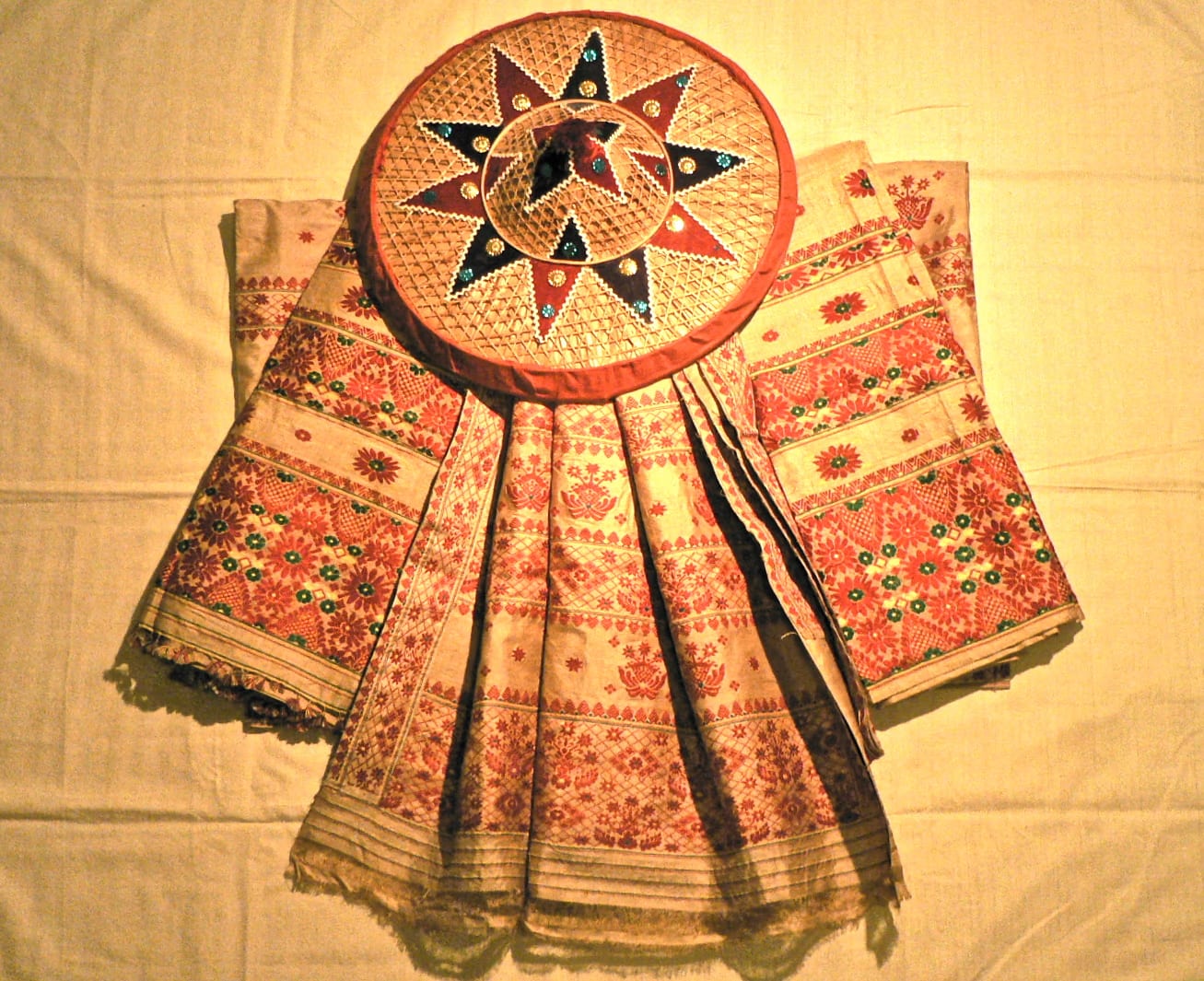
The japi is the conical hat of Assam. It is a broad, shallow cone of woven bamboo and palm leaf. Alongside the gamosa, it is one of the emblems by which the valley is known. The hat is built on a frame of finely split bamboo, and often cane, and faced with the large leaves of the tokou palm. The name is generally traced to the word jaap, a bundle of tokou leaves, from which the cover is made. At root the japi is the most practical of objects, a sunshade and a rain-cover for the worker in the open field. Yet in its ornamented form it has become a thing of pure ceremony and decoration. It is hung on a wall, given in welcome, and worn in the festival dance. The two japis, the plain working hat and the decorated ceremonial one, sit at the opposite ends of a single craft. Between them they carry the look of Assam.
Bamboo, tokou leaf and the maker's hand
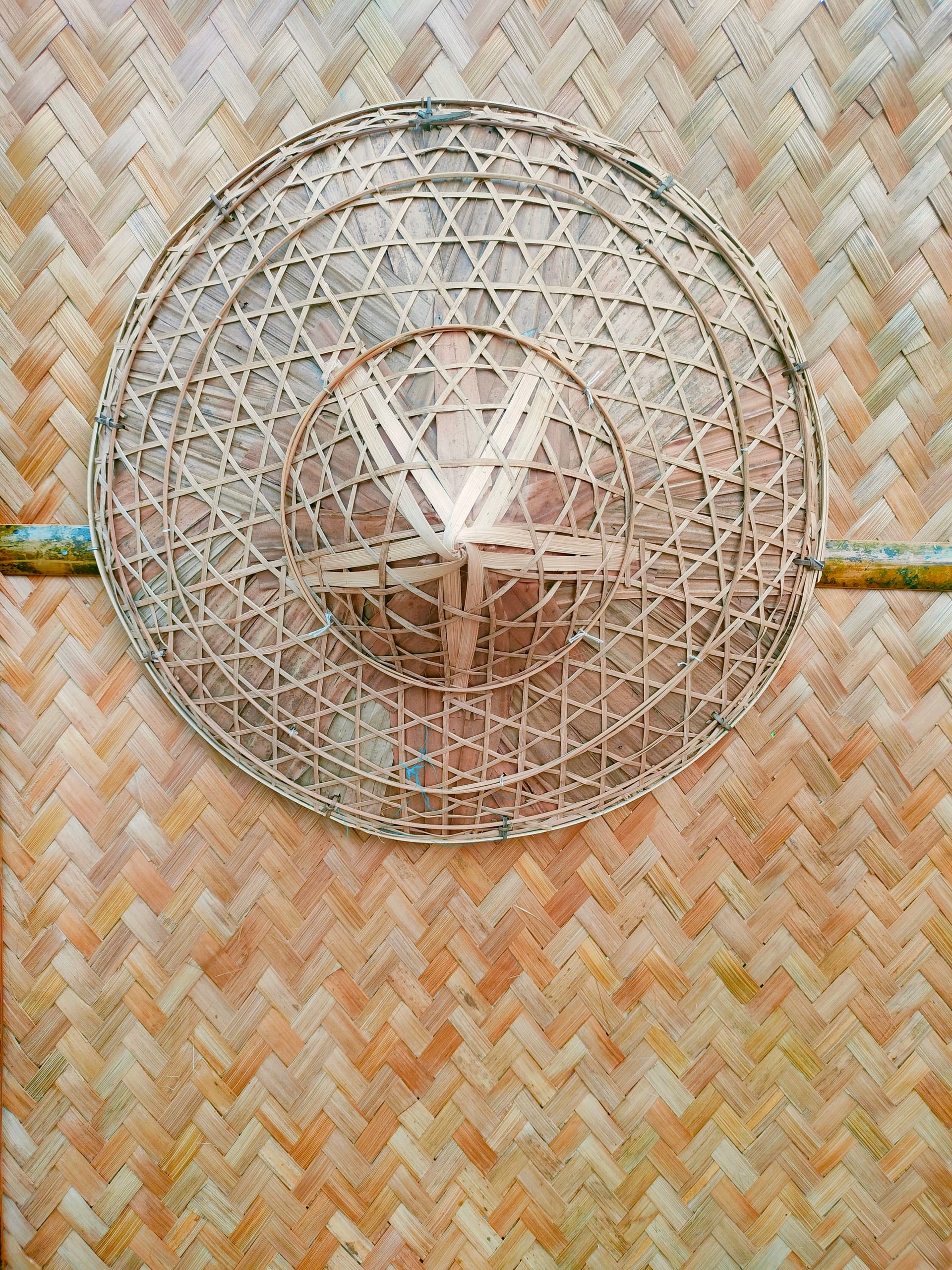
The japi is made of what the valley grows. Its strength is in the bamboo. The bamboo is split into fine strips and woven into the broad cone and the supporting rings. Its surface is the tokou-palm leaf, large and weatherproof, layered over the frame to throw off sun and rain. The leaf is that of the tokou palm, ‘Trachycarpus martianus’, whose fan-like fronds are dried and pressed flat before use. The work is wholly by hand. The bamboo is prepared and the leaf laid and stitched by makers who have carried the craft through families. The Barpeta country of western Assam is widely reckoned its best-known home, the district whose artisans are most associated with the hat, though the craft is practised across the valley.
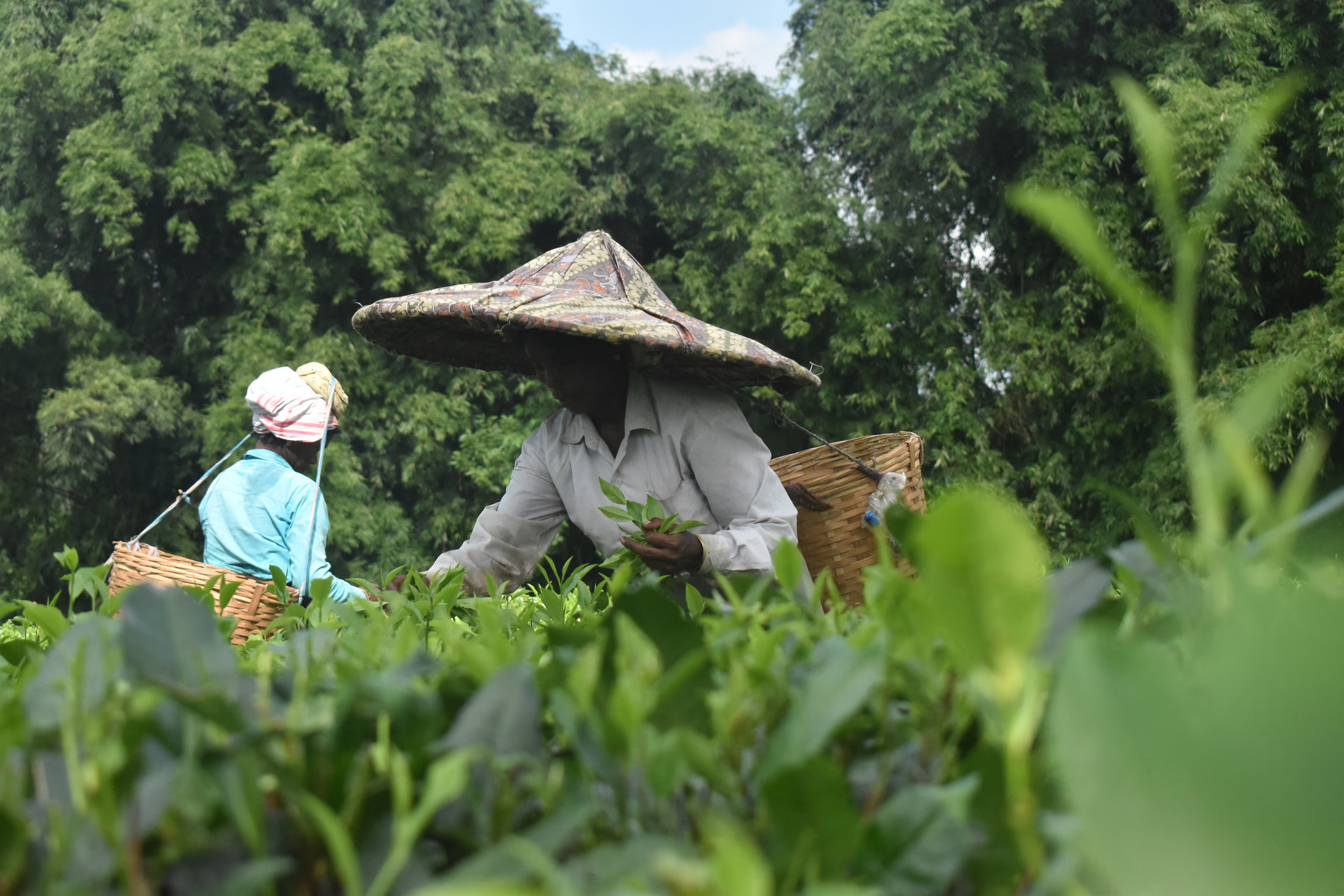
The plain hat comes in many working forms, and the older names for them track the wearer and the weather. In its plainest shape it is the field japi, an unornamented cone that the cultivator and the fisherman wear against sun and rain. Tradition also records a haluwa or panidoi japi for the ploughman, a garakhiya japi for the cattle-herd, and lighter forms carried against the monsoon. These are pieces of everyday material culture of the kind B.K. Barua surveyed for early Assam, made to be used rather than admired.
The phulam japi
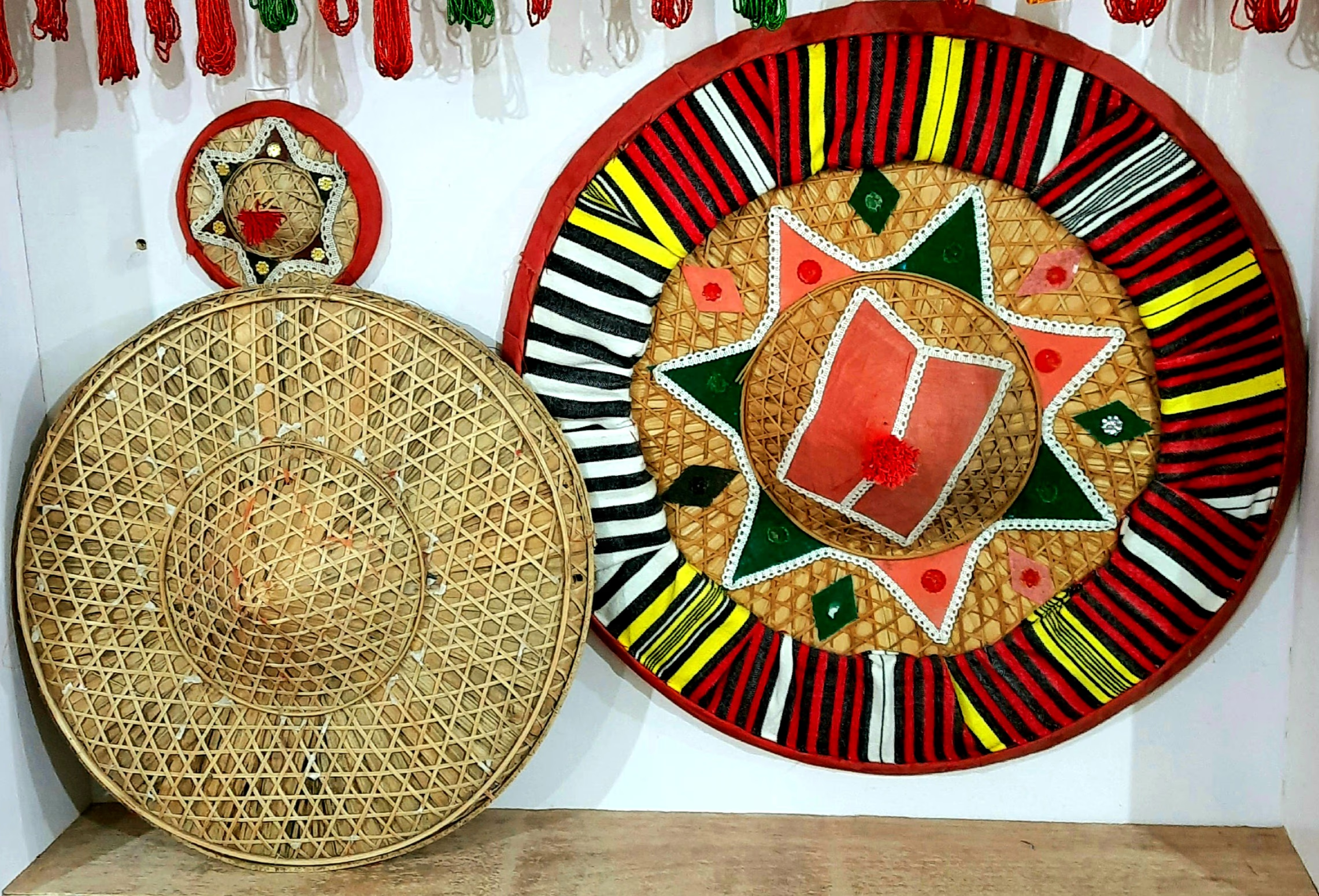
From the same craft comes the phulam japi, the flowered or ornamented japi. It is a different thing altogether. Here the maker covers the leaf cone with coloured cloth and works it over with intricate designs. The cloth patterns run to red, white, green, blue and black, set into or laid over the weave, and the finer hats add appliqué and small mirrors and tinsel. A separate ornamented form, the sorudoi japi, is worked with dense cloth patterning and is by tradition carried by women, and especially by brides. Many finished japis are topped with a small cap-like metal ornament called the sula, fixed at the crown of the cone. In these forms the humble field hat becomes a brilliant, decorative object. It is no longer worn to keep off the sun. It is hung on the wall as an ornament of the Assamese home. It is given as a mark of respect and welcome to an honoured guest. It is also worn or carried in the festival, where it tops the dress of the Bihu dancer as part of the look of the Bihu stage. In this form the japi is the craft’s ceremonial face. It is the counterpart to the plain hat and the one most often seen as the emblem of Assam.
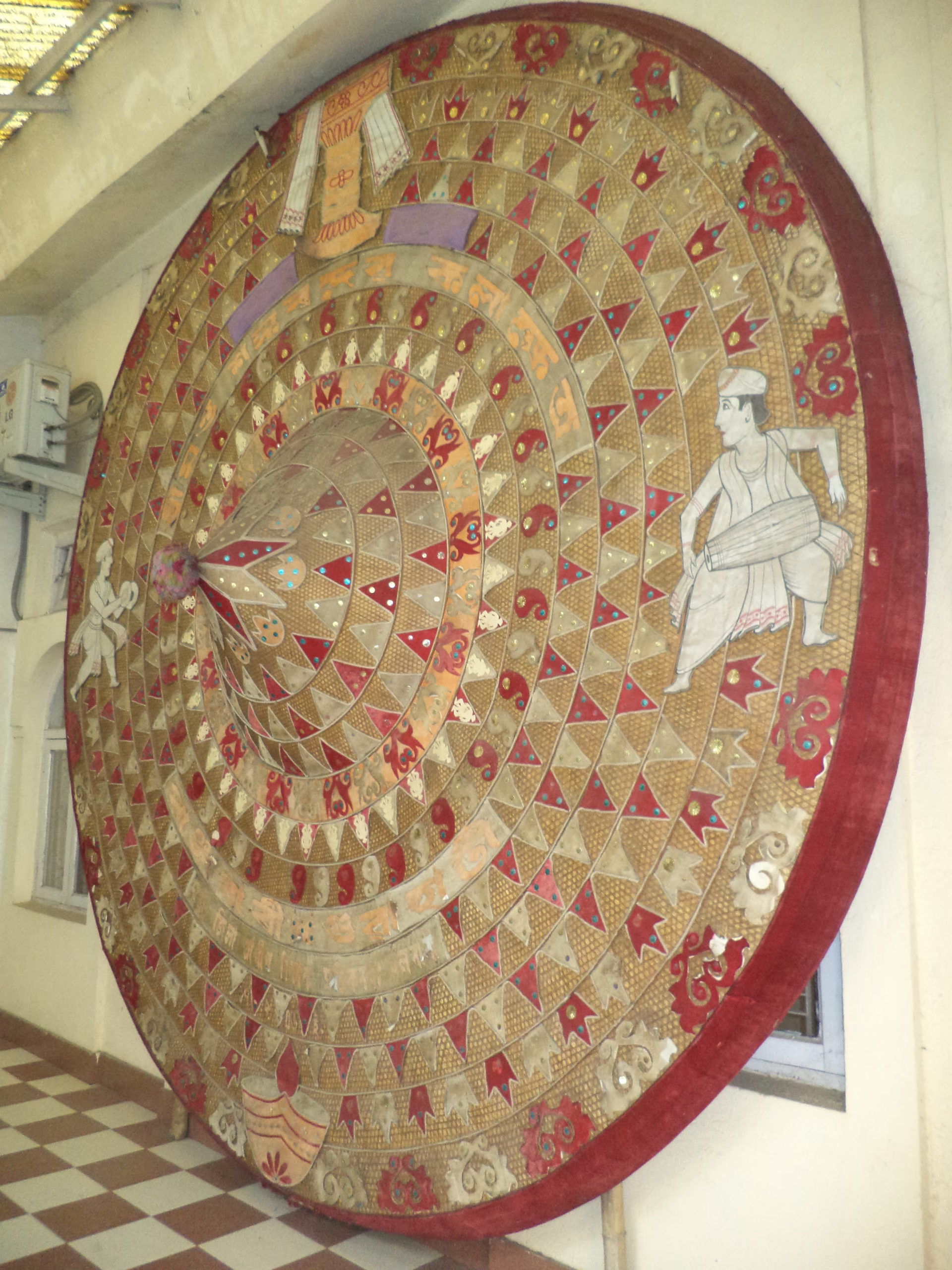
The royal japi and the emblem of Assam
The japi has long carried rank as well as shade. The old kings of the valley sat beneath the royal japi, the great ornamented hat held over a ruler as a canopy of state, its metal sula worked in silver or gold. The making of such hats was itself an organised trade. Under the old order a guild of japi-makers, the japi-hajiya khel, is recorded, and its craft is tied in the chronicles to the Chutia country of the far east.
That eastern connection runs through the japi’s earliest documented history. The ornamented hat appears as a royal and diplomatic object in the dealings between the Chutia kingdom of Sadiya and the rising Ahoms. By the accounts preserved in the chronicles, embroidered japis of gold and silver passed between the courts in the years before the Ahom king Suhungmung annexed Sadiya. That conquest, the fall of Sadiya of 1523–24, drew the Chutia east into the Ahom realm, and with it the hats and the craft that had marked its kings. A silver japi still figures among the heritage objects of the old courts. All of this is a sign that the hat marked dignity and authority, and not merely the weather.
From that history and from its festival use, the japi has become one of the great emblems of Assamese identity, standing with the gamosa. The hat and the cloth together stand for the valley wherever it wishes to be seen, on the stage, in welcome, and as the recognised image of Assam. It is a clear case of the way an Assamese craft moves from the field to the festival. The same woven cone serves the cultivator in the sun and the king beneath his canopy. The practical and the ceremonial are held in a single object.