Momai Tamuli Borbarua was born about 1590. He was the administrator who gave the Ahom kingdom the machinery that let it become a great power. He built the paik system of organised labour and militia. That system underwrote every war and every great public work. He also held the high office of Borbarua, through which much of the kingdom was governed for the rest of its life. He is remembered too as the father of Lachit Borphukan, the soldier who broke the Mughals at Saraighat. So one family stands for two halves of the Ahom achievement: the administrator who built the system, and the general who commanded what it raised.
From a gardener to the first Borbarua
Momai Tamuli's rise is the classic Ahom story of advancement by ability within a tightly ordered state. By the buranji tradition he was born into a humble family at Garhgaon. He bore the names Sukuti Tamuly and Chiring Phiseng before his office gave him the one history remembers. The title Tamuli itself marks a man set over the areca-nut gardens, and tradition has him begin in just such modest service. It was his competence, not his birth, that carried him up. Swargadeo Pratap Singha (reigning 1603 to 1641) was the king who did more than any other to organise the Ahom state for war and government. He took Momai Tamuli into the royal service and raised him through its ranks. In time he made him the first holder of the new office of Borbarua. That a gardener's son could become the chief executive of the kingdom is itself a comment on how the early Ahom state worked. It was a system in which careful organisation and demonstrated merit could lift a commoner above men of older lineage.
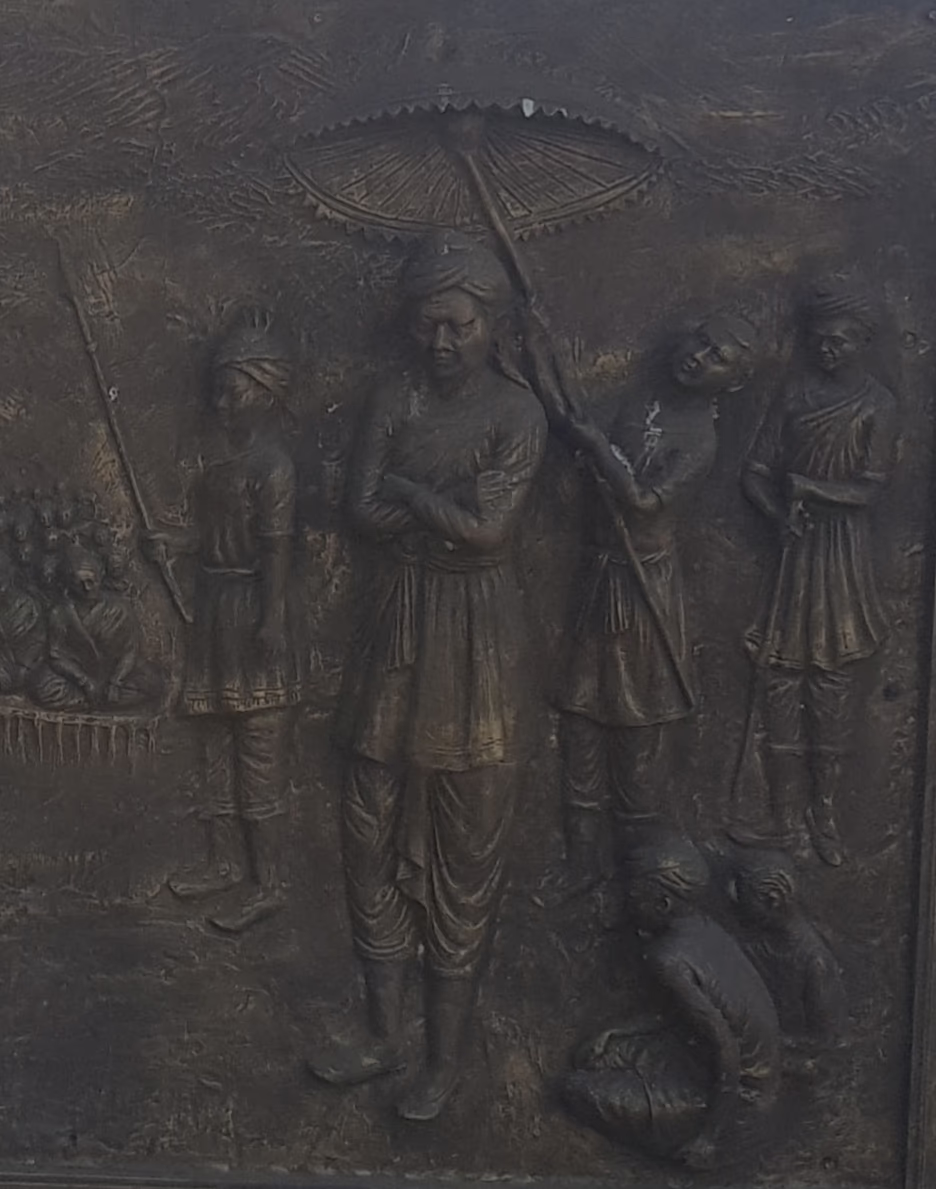
The paik census and the machinery of the state
His central and enduring achievement was the great census and reorganisation of the paiks. He carried it through with Pratap Singha's backing, and by tradition the work was set in hand early in the reign. On it rested the whole later strength of the kingdom. The census registered every able-bodied man, by custom those between about fifteen and fifty, and bound him to rotating service to the crown. He is also credited with laying out model villages, so that the ordering of settlement and labour went together. The paiks were grouped into the unit the Ahoms called a got, three or four men together. The got was organised so that one man was always serving the state while the others worked the land that fed them and their families, the burden of service revolving among them by turn. Above the got rose a pyramid of command, the paiks gathered under officers reckoned in round hundreds and thousands. The whole apparatus, men, officers, and the lands that supported them, was organised into the functional guilds the kingdom called khels. Each khel was charged with a particular service to the state, whether soldiering, boat-building, brick-making, the working of metal, or the supply of any one of the hundred goods a court and an army needed.
The genius of the arrangement was that it gave the kingdom a standing reserve of soldiers, boatmen, builders and artisans without the cost of a salaried army or a paid bureaucracy. The state paid its paiks not in coin but in land, the right to cultivate a holding in return for service. So the same population that tilled the valley in peace could be called to the oars and the ramparts in war. It was this system, the paik bound to his got and his khel, that made possible the great tanks and temples and palaces of the golden age. It also sustained the long river wars against the Mughals. The chapters that lean on the paik and khel system are leaning, at the root, on the census Momai Tamuli carried through.
The offices of state
Momai Tamuli is bound up with the design of the great executive offices through which the kingdom was administered. The office of Borbarua that Pratap Singha created for him was the chief revenue, judicial and military authority over the eastern and central tracts of the kingdom. It was a counterweight within the council of state to the older hereditary Gohains. It endured as one of the two great viceregal offices for the rest of the dynasty's life. Its western counterpart was the Borphukan, the viceroy who governed Lower Assam from Guwahati and commanded the frontier against Bengal. That office took its developed form in the same reordering of the state for war and government. It was to the Borphukanship that his son Lachit would later be raised. The pairing of the two offices, the Borbarua in the east and the Borphukan in the west, framed the administration of the kingdom for two centuries.
Soldier, diplomat, and the family he left
The Borbarua was no mere clerk of the census. Under Pratap Singha and after, Momai Tamuli was a soldier and a statesman in the Mughal war on the western frontier. He led Ahom forces in the field against the Mughals in the campaigns of the late 1630s. In 1638 his troops defeated a Mughal advance at Duimunisila and drove it back toward Guwahati. His name is tied to the boundary settlement that closed that round of the conflict, the Treaty of Asurar Ali of 1639, concluded with the Mughal commander Allah Yar Khan. That treaty fixed the frontier between the Ahom kingdom and Mughal Bengal along the Barnadi on the north bank and Asurar Ali on the south. After Pratap Singha's death he remained one of the steadying powers of the state. Through the 1640s he was in effect the manager of its dealings with the Mughals, firm in defence of the frontier and the kingdom's dignity, refusing more than one Mughal demand and holding trespassers who crossed into Ahom territory.
He was the head of a family that would fill many of the kingdom's high seats. By tradition he had seven children. His daughter, known as Pakhori Gabharu, became a queen of the Ahom kings Jayadhwaj Singha and Chakradhwaj Singha. Several of his sons rose to the great offices, among them a Laluksola Borphukan and a Marangi Borbarua. His youngest son was Lachit Borphukan, whom he raised in the disciplines of the state and the field. The year of his own death is not settled in the record. It is given by some accounts as 1663 and by others as earlier, around 1650, in the years of mounting Mughal pressure that would culminate in Mir Jumla's invasion. His life's work, the registered paiks and the offices of state, outlasted him. It became the institution on which his son Lachit would draw to fight the empire to a standstill on the river.