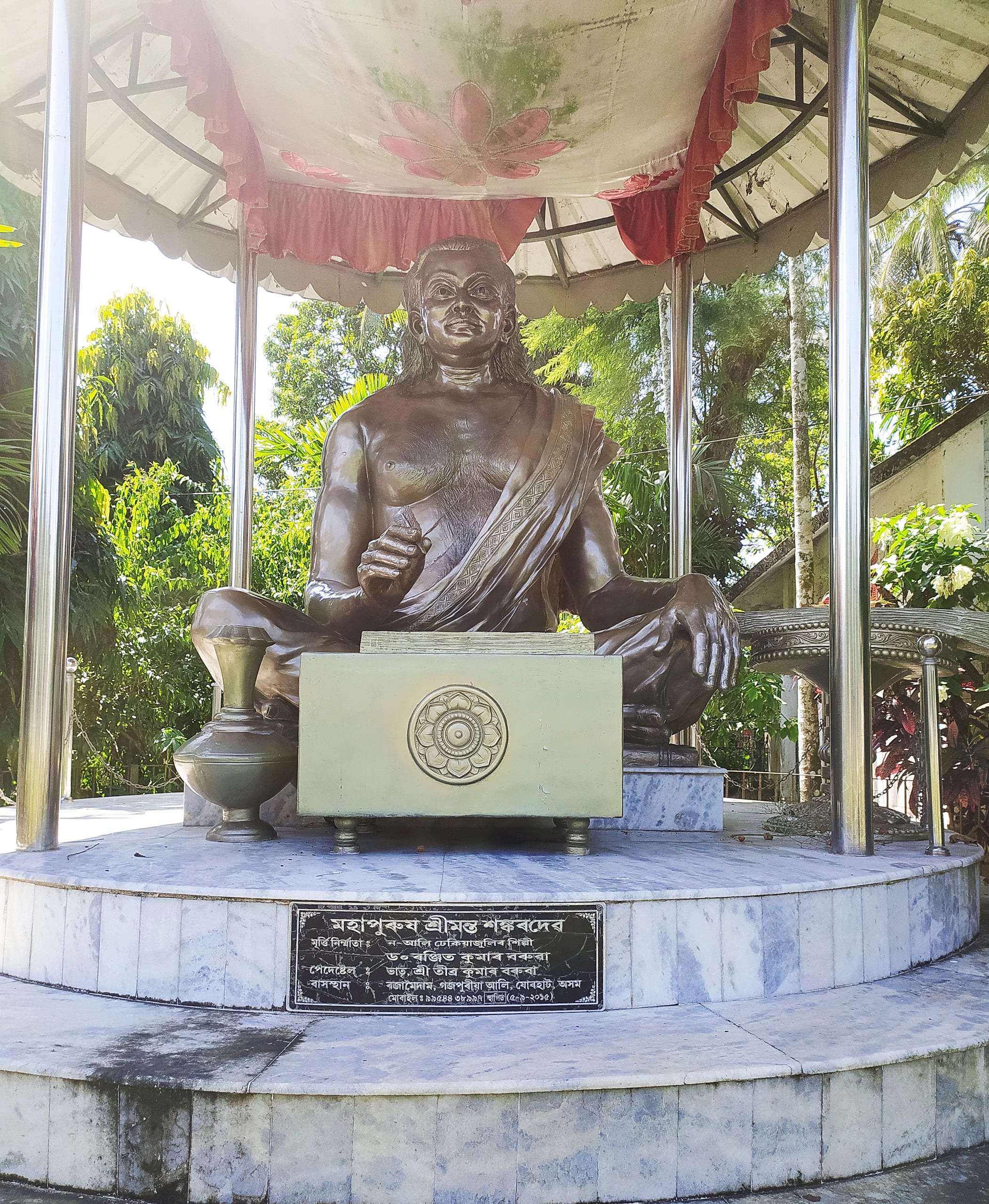
Srimanta Sankardev is the central figure of Assamese culture. He was the saint, poet and reformer who founded the neo-Vaishnava movement, and with it much of what is now recognised as Assamese. By the traditional reckoning he lived from 1449 to 1568. The hagiographies give this as a life of some 120 years, which modern scholars do not accept as literal, and some place his birth several decades later. He was more than a religious teacher. He was the architect of a whole devotional civilisation of faith, language, song, dance, drama and the institutions to carry them, and that civilisation outlasted every kingdom of his age.
The making of a saint
Sankardev was born into the world of the Bara-Bhuyans, the loose confederacy of landed chiefs who held the central valley in the interval between the decline of the old Kamata kingdom and the reach of the rising Ahom power from the east. His family were Kayastha chiefs of that order, and his father Kusumbar held the first rank among them, the title of Siromani. The details of the childhood, the late start at the tol of the pandit Mahendra Kandali, the first devotional hymn composed from a bare handful of letters, and the honorific Sankaradeva that the feat is said to have won him, reach us through the charit-puthis, the devotional biographies written a century and more after his death, and are told as a story in their own right elsewhere on this site. What the record holds firmly is that he was trained in the full Sanskrit learning of his day, took up his father's office and married, and then, in early manhood, lost the young wife who had borne him a daughter. That grief turned him from the life of a chief toward the life he would make his own.
Before he left he had already shown the cast of mind that would define him. Around 1468, by tradition, he staged the Chihna Yatra, a silent spectacle of painted scenes carried on cloth, among them a set of the seven heavens of Vishnu, performed to the music of drums and cymbals he had designed himself. It reached back to the older Oja-Pali narrative song and the puppet theatre of the valley, and it pointed forward to the devotional theatre he would go on to invent. Then, placing his daughter with relatives, he set out on a pilgrimage across the holy places of northern India that tradition reckons at some twelve years, taking in Puri, Gaya, Mathura, Vrindavan, Badrikashram and the other great centres. He travelled at the height of the Bhakti movement, the wave of personal, congregational devotion that was then remaking Hinduism from the Tamil country to Bengal, and he was a near-contemporary of Chaitanya of Nabadwip, whose Krishna-devotion was transforming the neighbouring lands to the west. He returned to Bardowa a preacher with a faith to give rather than a scholar in search of one, raised there his first house of prayer, and began to gather the congregation that would become a movement.
Eka Sarana Nama Dharma
The faith Sankardev preached was the Eka Sarana Nama Dharma, the religion of taking sole refuge in one God through the chanting of his Name. Its God was Krishna, understood not as one incarnation among many but as the supreme being himself, Narayana, of whom every other god and avatar was only a partial expression. This was a strict monotheism, and Sankardev pressed it hard against the crowded pantheon of the valley. He set aside the worship of images, the blood sacrifice of the goddess cults, and much of the Tantric and Brahmanical ritual that then dominated Assam, and in their place he put a devotion that asked for nothing but the Name, the sacred word chanted and heard in the company of others.
Of the nine traditional forms of devotion Sankardev rested his path on two, sravana and kirtana, the hearing and the singing of God's names and deeds, and of these he made congregational song the very heart of worship. The mood of that devotion was dasya bhava, the love of the servant for his master, sober and reverent, and here his path parted from the Gaudiya Vaishnavism of Bengal, which took the romantic love of Radha for Krishna as its highest key. Sankardev did not worship Radha at all. His Krishna was lord and not lover, approached as a servant approaches a king. Above all the faith was open. It set aside the claims of caste and birth and drew the high and the low together, Brahmin beside Kaibarta, and beyond the Hindu fold it reached the tribal peoples of the hills and the Muslims who came to it, one of whom, remembered as Chand Sai, was received as a devotee.
The doctrine came in time to rest on four things, the char vastu, which the tradition names as nama, the Name, deva, the one God, guru, the preceptor, and bhakat, the congregation of the devout. Sankardev himself taught the Name, the God and the congregation. The fourth pillar, the reverence owed to the guru, was raised into a principle after him by his great disciple Madhavdev, who took his master as his own object of devotion and fixed that veneration at the centre of the faith. It was a radical simplification of Hindu practice, and in a land then thick with ritual it is the ground of the movement's lasting hold.
The body of work
He carried the teaching not in Sanskrit but in the people's language, and left a vast body of writing to hold it. He rendered much of the Bhagavata Purana into Assamese, freely adapting it for devotion, his hand covering Books I and II, parts of Books VI, VII and VIII, and Books XI and XII, along with the celebrated first half of the tenth Book, the Adi Dasama, on the childhood of Krishna. The remainder of that great Book, and others he had begun, were completed by his disciples, so that the Assamese Bhagavata is the labour of more than one generation. He put the Uttarakanda of the Ramayana into verse, taking up the work the earlier poet Madhava Kandali had left unfinished, and he composed the Kirtan Ghosha, the long book of devotional verse that became the household scripture of the movement and is still sung in the prayer houses today.
His original and doctrinal works ran alongside the translations. The Gunamala, a jewel-like verse epitome of the whole Bhagavata, was written at speed for the Koch king, and the Bhakti Ratnakara in Sanskrit, the Nimi Navasiddha Samvada and the Bhakti Pradipa set out the teaching in more formal terms. For the stage he created the Ankiya Naat, one-act plays on the deeds of Krishna, of which six survive, among them the Rukmini Harana, the Kaliya Daman, the Patni Prasada, the Keli Gopala and the Parijata Harana. For his songs and plays he shaped an artificial literary tongue, Brajavali, a Maithili-based idiom carrying an Assamese vocabulary that was common to the wider Vaishnava world of the east, sonorous and a little archaic, fit for the mouths of gods upon the stage.
The cultural apparatus he built
Around the faith Sankardev built a complete cultural system that still defines Assam. At its centre stood the namghar, the village prayer-hall open to all, with the sacred book and not an image upon its altar, which became the meeting-house of the community and the seat of its self-government as much as its worship. Beside it grew the sattra, the monastery that after him developed into a school of art, a repository of manuscripts and a unit of rural society, holding land and gathering disciples under a line of abbots. These two institutions carried the movement into every locality, and because both welcomed people without regard to birth they knit caste and tribal communities alike into a single religious life.
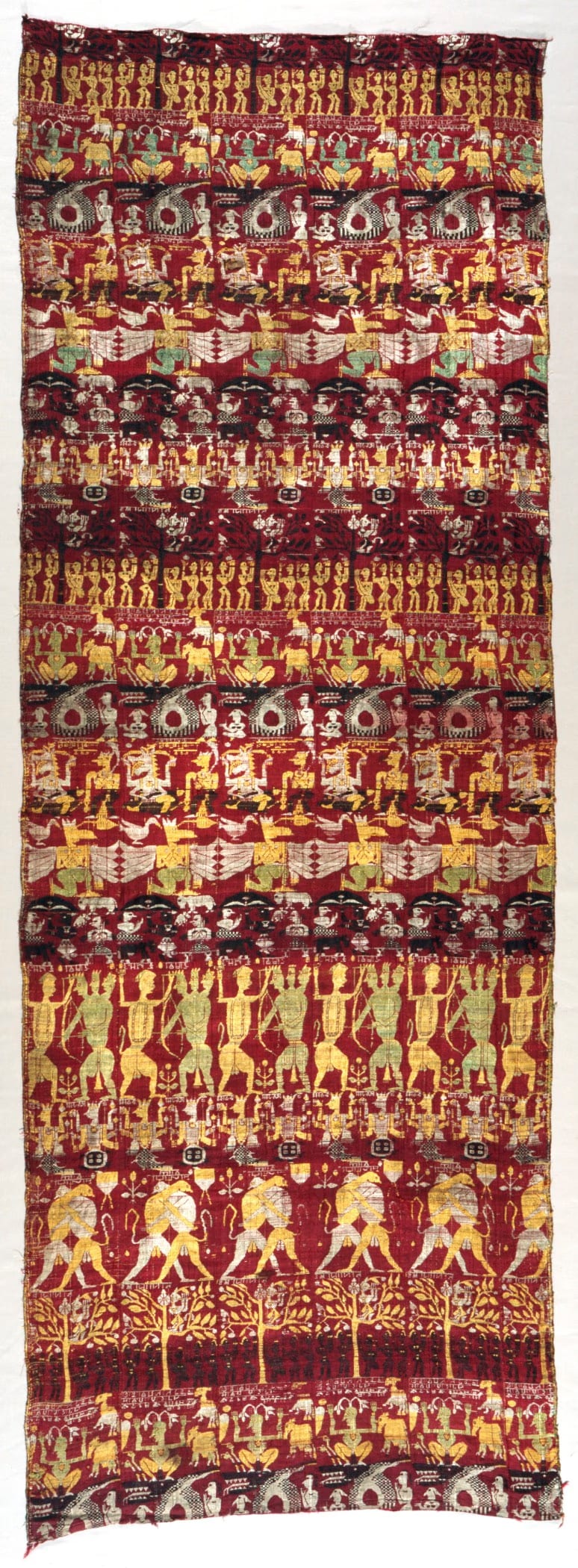
The movement arrived complete with its own arts. It included the Borgeet, Sankardev's corpus of grave and stately devotional song, of which he is said to have composed some 240, though only about three dozen survive after a fire destroyed the manuscript a devotee had been keeping. It included the Ankiya Naat dramas and their all-night Bhaona performance, and the Sattriya dance that grew from them within the sattras and is now counted among the classical dance forms of India. And it included the woven Vrindavani Vastra, the great tapestry depicting the Vrindavan exploits of Krishna, first commissioned in his own lifetime and woven in the tradition long after. Few founders anywhere have left so integrated an inheritance, a religion that came ready-made with its literature, its theatre, its music and its civic architecture. Of all those creations the Vrindavani Vastra had the strangest fate, carried far from Assam, its surviving fragments now held in museums abroad.
The Vrindavani VastraA saint set twelve weavers to weave the whole life of Krishna into one vast silk. It vanished over the Himalayas, was cut up by monks who could not read it, and ended scattered across the world's museums.Read the story →Persecution and the Koch refuge
A movement that brushed aside caste and ritual drew the hostility of the Brahmanical orthodoxy and the suspicion of kings, who saw in a preacher who gathered thousands a rival to their own authority. Sankardev was pushed from place to place, from Bardowa to Dhuwahat in the Ahom country near Majuli, and on again. It was at Dhuwahat that he met and won over Madhavdev, turning a young man set on the goddess and her sacrifices into the movement's greatest devotee and poet. But Ahom displeasure fell hard upon them. His son-in-law Hari was put to death and Madhavdev was imprisoned for a year, and in his later years Sankardev crossed west out of Ahom reach into the territory of the Koch.
There he found protection at the court of Naranarayan, whose brother and general Chilarai, born Sukladhwaj, became his follower and his shield. It was Chilarai, by tradition, who turned aside the charges of the saint's enemies and secured him a hearing before the king, and under that patronage the faith was made safe and its art flourished. Sankardev settled at Patbausi near Barpeta, and it was for this western court that the Vrindavani Vastra was first woven. The island of Majuli and the sattra at Barpeta grew in time into the heartlands of the movement.
Succession and legacy
Sankardev died in 1568 at Bheladunga, near the Koch capital in what is now Cooch Behar, by tradition at the great age of 120. His foremost disciple, Madhavdev, carried the movement on and gave it much of its finest song, the Naam Ghosa above all. But the faith did not remain one after its second generation. Differences over doctrine and practice, over the place of Brahmins and image-worship and the line of true succession, split the sattras into four great orders, the samhatis, which persist to this day. The Brahma samhati, led by Brahmin teachers such as Damodardev, readmitted much of the Brahmanical and Sakta usage the founder had set aside. The Purusa samhati gathered around Sankardev's own descendants. The Nika samhati, growing from the line of Madhavdev, held to the strictest and most austere observance, and the Kala samhati, founded by Gopaladeva of Bhawanipur, spread furthest among the tribal and lower-caste populations and became the most numerous of all, embracing in time the powerful Moamaria sattra whose followers would one day rise in revolt against the Ahom state.
Across the centuries the sattras carried the faith through the length of the valley and out into the surrounding hills, so that a religion born in one man's grief became the common devotional world of a whole people. Venerated as the Mahapurusha, the great soul, Sankardev is credited by the historians of Assam, more than any king or conquest, with forging a single Assamese identity out of the valley's many peoples and tongues. He gave them a shared faith, a shared literature and a shared stage, and long after the kingdoms that persecuted or protected him had passed away, the namghar he built still stands at the centre of the Assamese village.