There is a cloth as long as a village lane, woven from end to end with the life of a god. For four centuries it has lived about as far from the looms that made it as a thing can travel and still exist. It was made in Assam in the sixteenth century, and then it was lost over the Himalayas, cut to pieces by men who could not read a word of it, and scattered at last across the great museums of the world. Its name is the Vrindavani Vastra, the cloth of Vrindavan. None of those who saved it ever knew what it said. It is the story of how something so wholly Assamese travelled so far, and of how, after more than a century abroad, it is finally due home.
A god woven into silk
It began as an act of devotion under Srimanta Sankardev. He was the saint who founded the neo-Vaishnava faith of the valley. He remade Assamese culture around the chanting of the divine name. The full sweep of his life is set out on his own page. What matters here is one commission. By the accepted dating, in the years between 1567 and 1569, at his direction, the master weaver Mathuradas Burha Ata and twelve assistant weavers set a monumental length of figured silk on the loom. Sankardev had already given the new faith its books and its songs and its plays. Now he set out to give it a hanging that would carry the whole life of Krishna in a single woven sweep.
What is woven into it
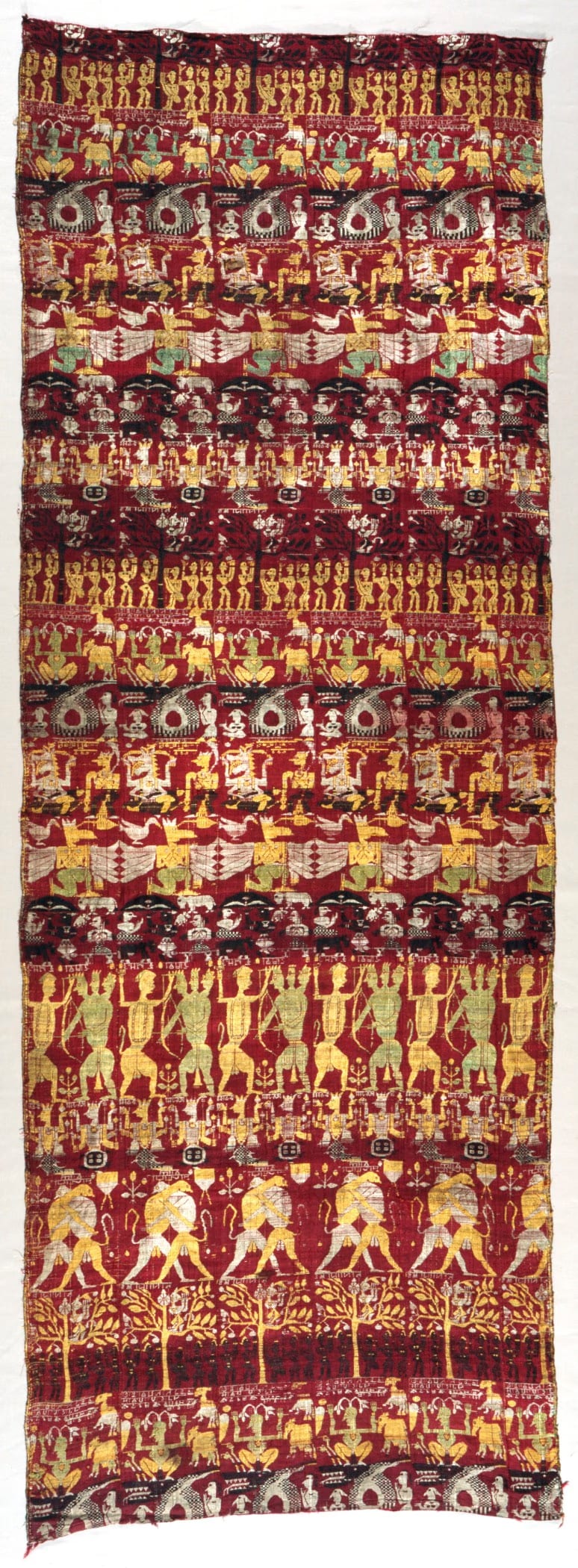
The cloth is composed in long horizontal registers that run the length of the silk. Its subject is the boyhood and youth of Krishna among the cowherds of Vrindavan, the cycle of deeds that Sankardev had himself turned into Assamese from the tenth book of the Bhagavata Purana, the book he loved above all the others. The great length now in London is dominated by one episode above the rest, the subduing of the serpent Kaliya. Krishna dances in triumph on the many hoods of the snake he has driven from the poisoned river, and the image returns again and again down the cloth. Around it runs the wider cycle the hanging was woven to carry, the demons of the pastures sent against the child, among them the crane-demon Bakasura, and the round dance with the cowherd women that the poets call the Ras.
The narrative does not run alone. Between the bands of story move rows of dancers, files of birds and animals, and tall flowering trees of the kind weavers across the region still call the tree of life. The incarnations of Vishnu, the dashavatara, are set out along the silk, and the sun-bird Garuda opens his wings across it. The whole is held within patterned borders, so that each scene sits in its own frame like a small shrine.
What sets the cloth apart from any painting of the same stories is that the words are in it too. Woven into the fabric, in the thread itself and not added afterward, run lines of Assamese script. Short labels name the scenes for a reader who already knows them, and through the design run verses from Sankardev's own dramatic composition on the Kaliya episode, so that the silk carries the god in the saint's exact words. This is the reason those who know it call it a woven scripture rather than a woven picture. To move along its length is to move through a recitation, one scene giving way to the next, the refrain returning with the dancing boy on the serpent's hoods.
The figured loom
To make such a thing was a feat of the loom as much as of faith. The technique is the figured double-weave that the Victoria and Albert Museum's catalogue calls lampas. It is a compound silk in which a patterning weft rides over a ground weave to build the images thread by thread. Its structure is so dense and so exact that two weavers must work a single loom together. One throws the shuttles of the ground while the other lifts and sets the figures. This was the high art of a valley that has always lived by its looms. The great hanging was not woven in one width. It was made in narrow loom-widths, each as broad as the frame allowed, and the strips were joined edge to edge into the single vast length.
The work was done under a court in exile. Sankardev was then in refuge in the Koch country to the west, sheltered by the Koch court of Naranarayan and his brother-general Chilarai. It is to that court, and that protection, that the great cloth is tied. The man who oversaw its making, Mathuradas Burha Ata, would in time organise the sattra at Barpeta into the lowland capital of the faith. So the cloth sits at the very root of the institution that carried neo-Vaishnavism down the centuries.
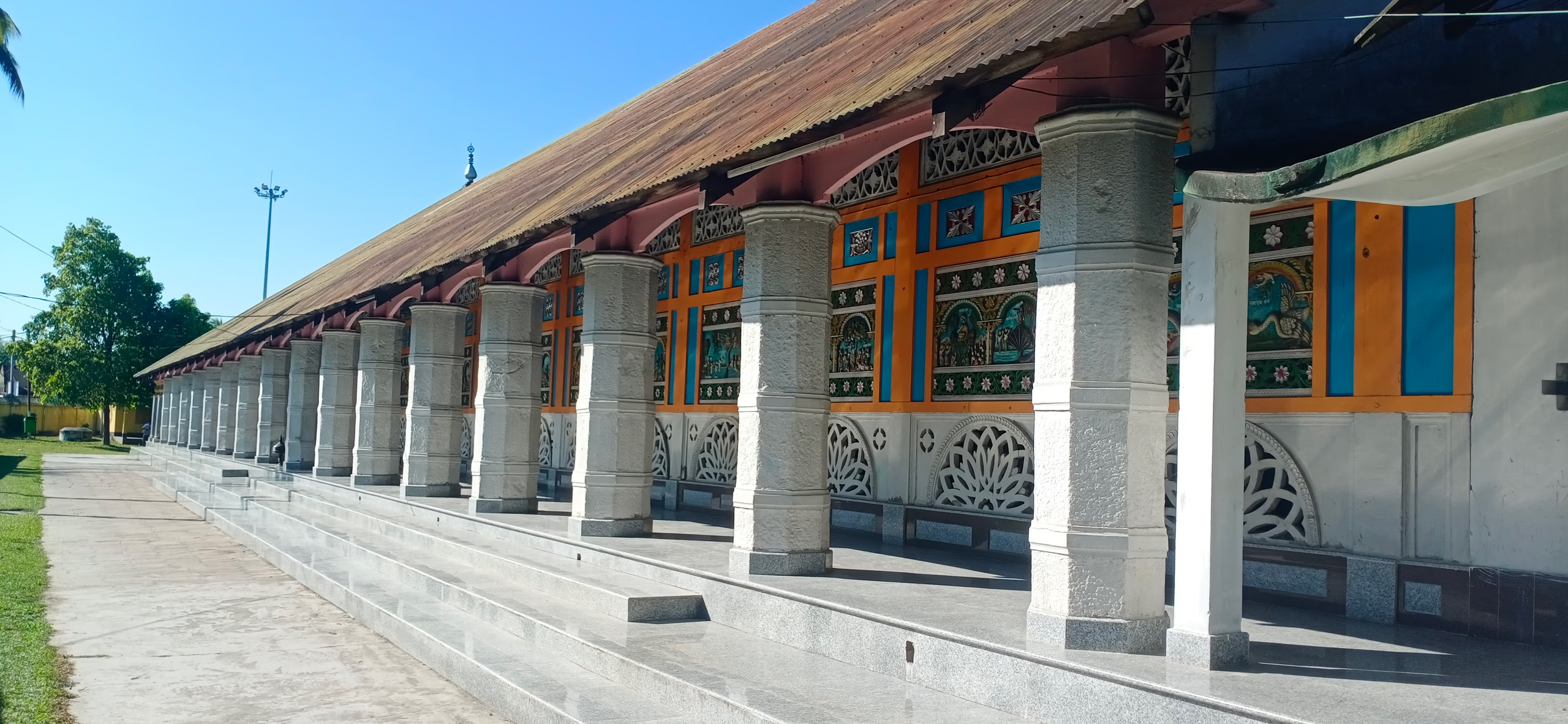
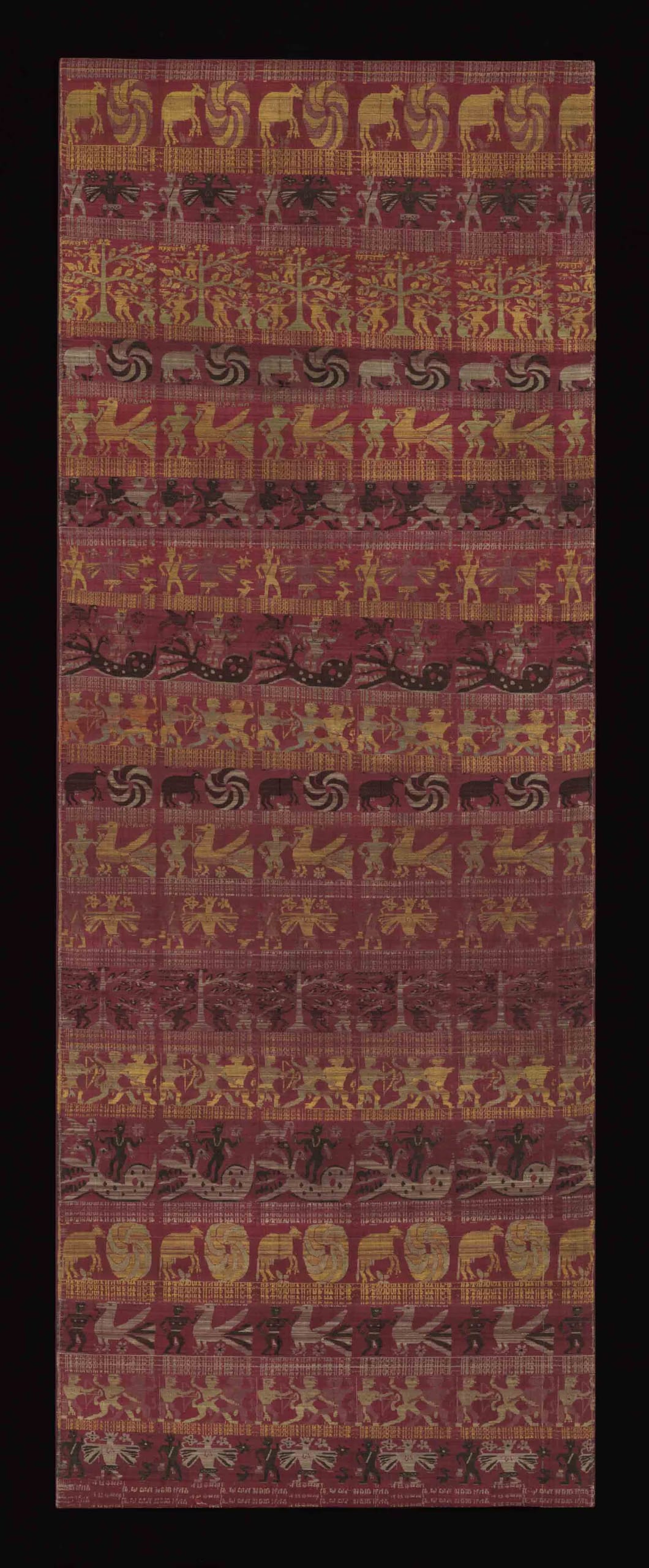
That deep skill did not die with the great cloth. Another figured silk from Assam survives in the Metropolitan Museum, woven in registers of dancers, animals and trees of life, and it shows the very narrative-weaving tradition that produced the great cloth.
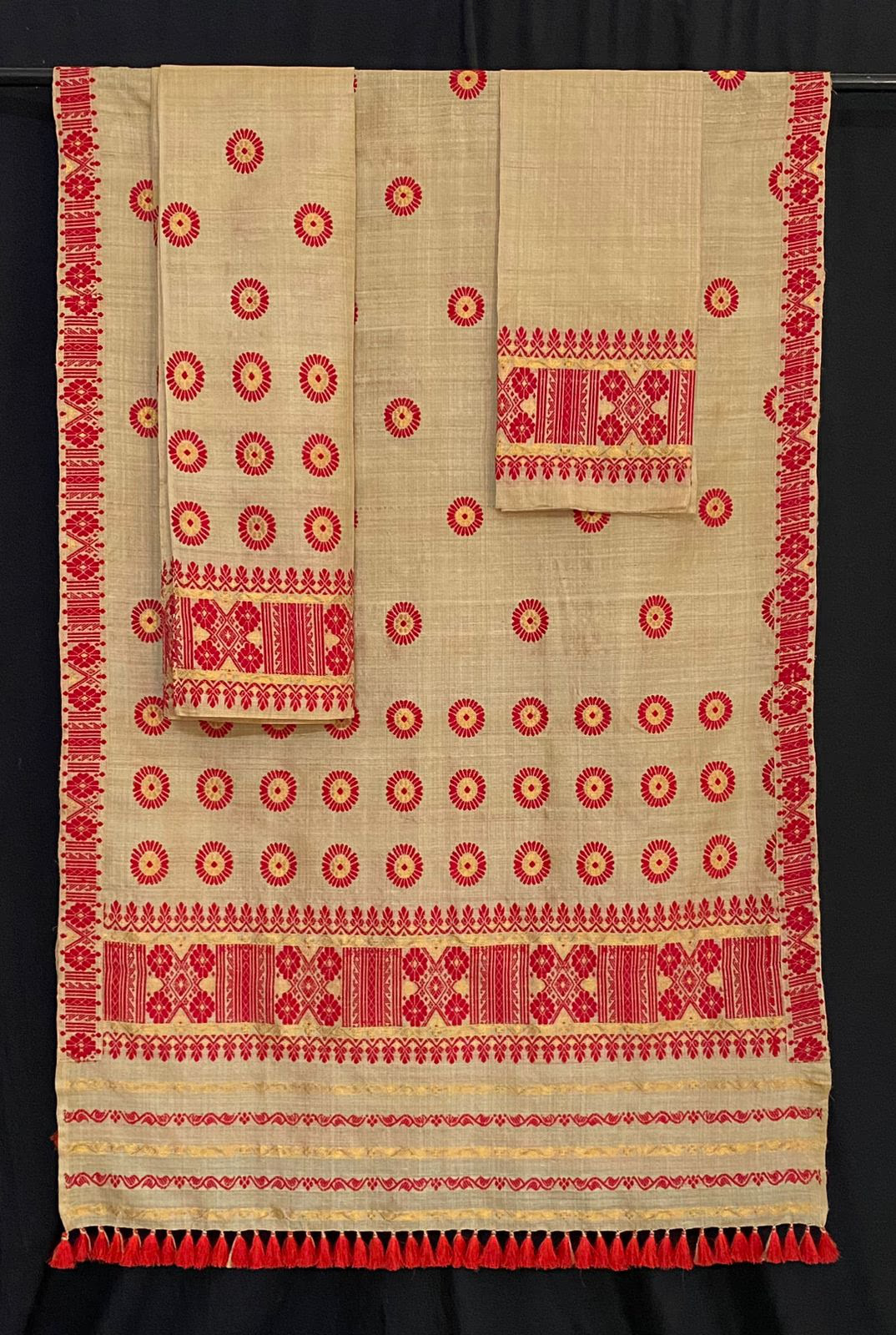
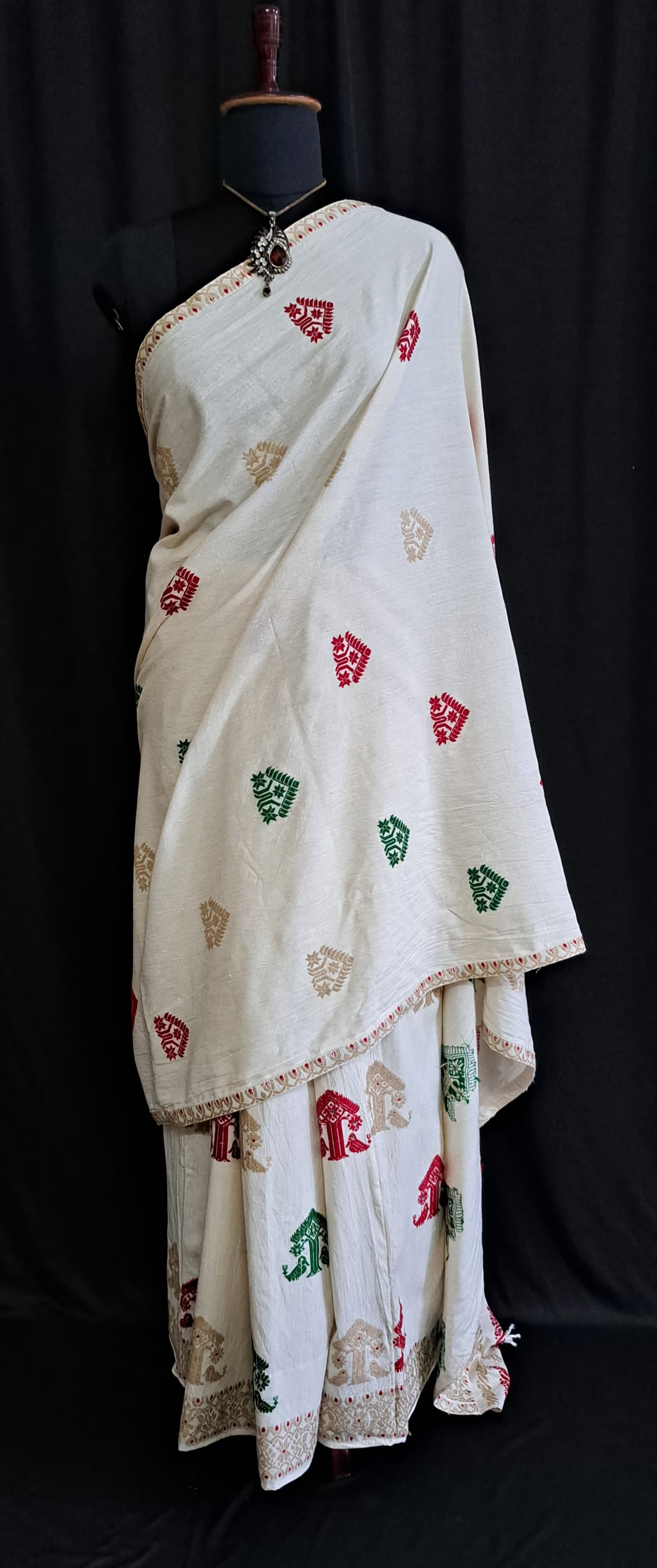
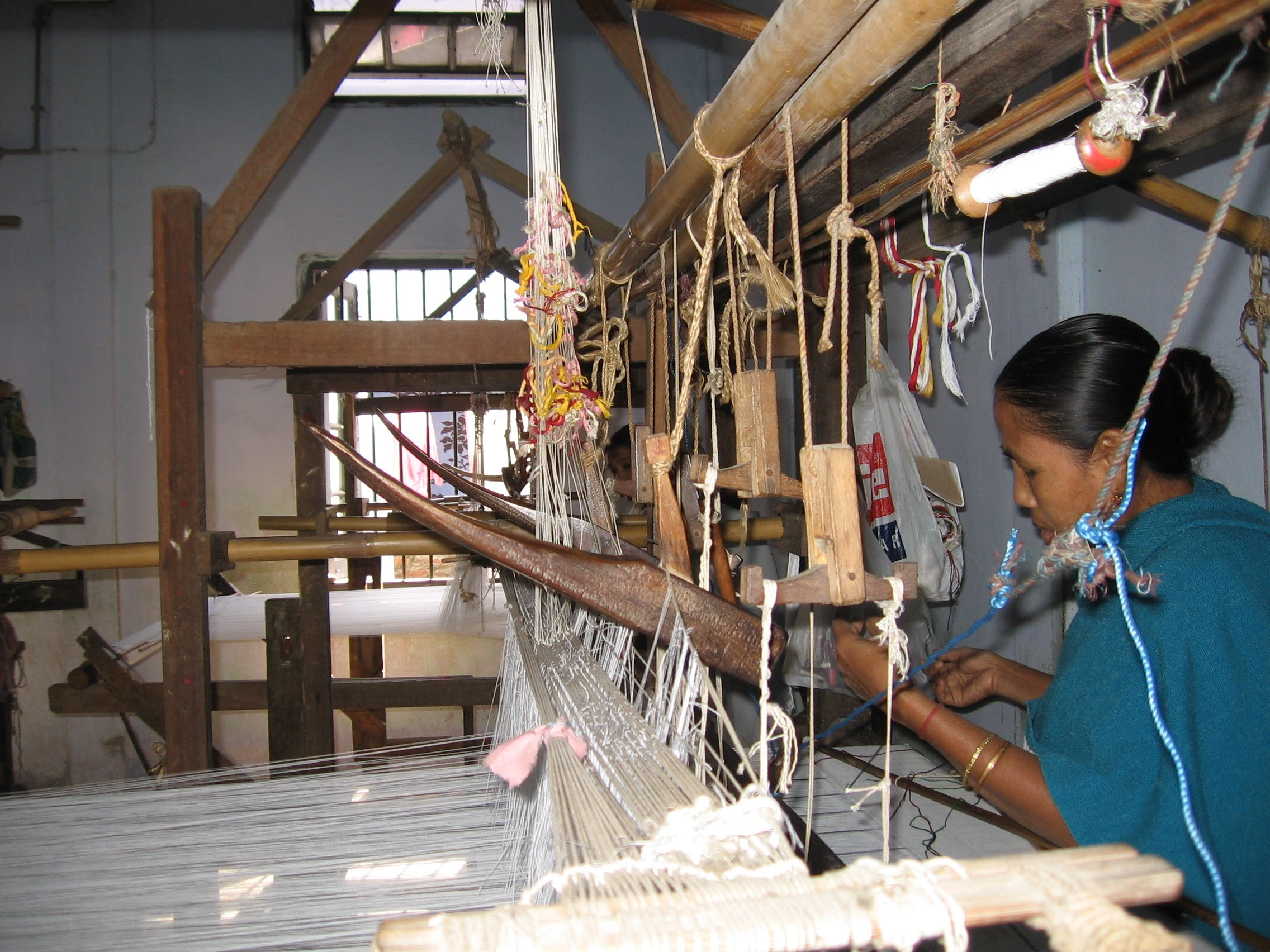
The same tradition survives today in the household workshops of Sualkuchi, the weaving town on the north bank of the Brahmaputra.
It survives too in the lustrous white pat silk of the bride and the festival.
Over the mountains, cut into strips
Then it left. No one can now say with certainty how it travelled. A cloth meant for a Vaishnava court in the Brahmaputra valley went north out of Assam, up through Bhutan and on into Tibet. But travel it did, and there it came to rest in a Buddhist monastery far from any place that knew its meaning. By the account of Richard Blurton, the British Museum curator whose study accompanied the 2016 exhibition, it was kept in a monastery near Gyantse. There the monks valued the foreign silk without ever being able to read the Vaishnava poetry running through it. To them it was beautiful cloth and nothing more. They used it the way they used beautiful cloth. They cut it into lengths and sewed those behind their painted thangka scrolls, as backing and lining for their own sacred images. It is a small irony with a large consequence. The very act that cut Sankardev's masterwork to pieces is also, in all likelihood, the reason any of it survives at all. A length of silk hidden behind a venerated painting is kept dry, kept dark, and kept safe for centuries. Everything left in the damp of Assam rotted away.
Scattered, and coming home
The cloth re-entered the wider world in 1904, in the baggage of empire. A British column under the Younghusband expedition marched on Lhasa, and a correspondent of The Times of London, by some accounts Perceval Landon, gathered up the old Assamese silk among other Tibetan curiosities and carried it back to England. The exact hands it passed through are uncertain, and only the route is sure. At the British Museum it was at first filed as Tibetan silk, since nobody there could place the dense weave or read the script worked into it. Only later was it recognised for what it truly was, a sixteenth-century Vaishnava textile from the Brahmaputra valley, its origin betrayed by the Assamese script woven through the design. That London length is about nine and a half metres long, and it became the heart of the museum's 2016 exhibition, “Krishna in the Garden of Assam”. Other pieces had drifted elsewhere by the same kind of chance, and fragments rest today in the Victoria and Albert Museum in London, the Musée Guimet in Paris, the Philadelphia Museum of Art, and the Los Angeles County Museum of Art. The body of a single cloth lies dispersed across four cities and two continents, and the London length remains the largest surviving textile of its kind.
For most of a century the story rested there. The great hanging lay in a case in Bloomsbury, admired by visitors who mostly took it for an exotic curiosity from Tibet rather than the work of an Assamese saint and his weavers. That is now changing. The British Museum has agreed to lend the cloth to Assam, where it is expected around 2027, roughly a hundred and twenty years after it reached London. It will be unrolled again within reach of the looms that first made it, in the valley where it was woven four centuries ago.