Kamakhya stands on the Nilachal hill above Guwahati. It is by tradition among the foremost of the Shakti peethas. It is also the living centre of tantric goddess worship in the Brahmaputra valley. What stands at its heart is unusual among the great temples of India. There is no anthropomorphic image. There is a cleft in the rock, kept moist by a natural spring, worshipped as the yoni of the goddess. To approach Kamakhya as a pilgrim is to climb a whole sacred hill. The great temple is only its summit.
The peetha and the myth
In the pan-Indian Sakta system, Kamakhya's standing rests on a myth: it is the place where the yoni of the dismembered Sati fell to earth. When Shiva carried the body of his dead consort across the world and Vishnu's discus cut it into pieces, each piece that fell made a peetha, a seat of the goddess. That the yoni fell here makes Kamakhya the seat not of a relic but of the goddess's creative and generative power itself, which is why it ranks so high among the peethas and why its worship centres on the generative principle rather than an image.
Running alongside that pan-Indian myth is a local one. Assamese tradition ties the hill to Naraka, the founding king of the Kamarupa origin story, and to the goddess's own presence in the valley before the Sanskritic frame arrived. The temple thus sits at the junction of two sacred geographies, one shared with the whole subcontinent and one particular to Assam. The textual authorities that fix its place, above all the Kalika Purana and the Yogini Tantra, were composed in Assam but late, and they describe the cult of their own medieval present far more reliably than they record any first-millennium foundation, so the shrine is certainly older than the books that explain it.
A fusion of cults
The classic modern study, Banikanta Kakati's, reads Kamakhya as a fusion. Beneath the Sanskritic Sakta overlay lies an older non-Aryan mother-goddess and fertility cult. It was of the kind widespread among the region's indigenous peoples. Over time it was absorbed into Brahmanical Hinduism and given a Puranic genealogy. On this view, the moist rock-cleft and the emphasis on the generative principle are not late tantric elaboration. They are the surviving core of the original cult. The very name Kamakhya, the goddess “famed as desire,” preserves that older charge.
Kakati's case rests less on any one document than on a pattern. The worship here has no anthropomorphic image, the very thing a fully Sanskritic cult would supply. It centres instead on a natural feature of the earth, a form of veneration at home among the region's tribal peoples. Kakati also pointed to the priestly service of the shrine, which historically drew on communities outside the standard Brahmanical order, and to worship names and usages that sit awkwardly with orthodox practice. The absorption, in his reading, was gradual: the local goddess was fitted with a Sanskrit name, a Puranic parentage in the Sati myth, and a place in the pan-Indian peetha network, without the underlying fertility cult ever being displaced.
It is an interpretation, not a settled fact. The Sanskrit sources that describe the shrine are late and cannot confirm what preceded them, so the pre-Aryan layer is inferred rather than documented. Yet the reading has shaped all later scholarship on the shrine, and it remains the standard frame through which the temple's departure from the ordinary temple-and-idol pattern is understood.
The garbhagriha and the Nilachal temple
The object of worship is below ground. From the assembly halls the pilgrim descends a flight of worn stone steps into a dim, damp rock chamber. There a sheet of stone slopes down from either side to meet in a natural cleft. This is a yoni-shaped depression, kept permanently wet by an underground spring that wells up through the rock. There is no image. The stone itself is the goddess, draped in silk and flowers and slick with water and vermilion. It is touched, anointed, and worshipped directly. This is the heart of Kamakhya, and the source of everything else about it. It is a shrine built not around a deity made by human hands but around a feature of the living earth.
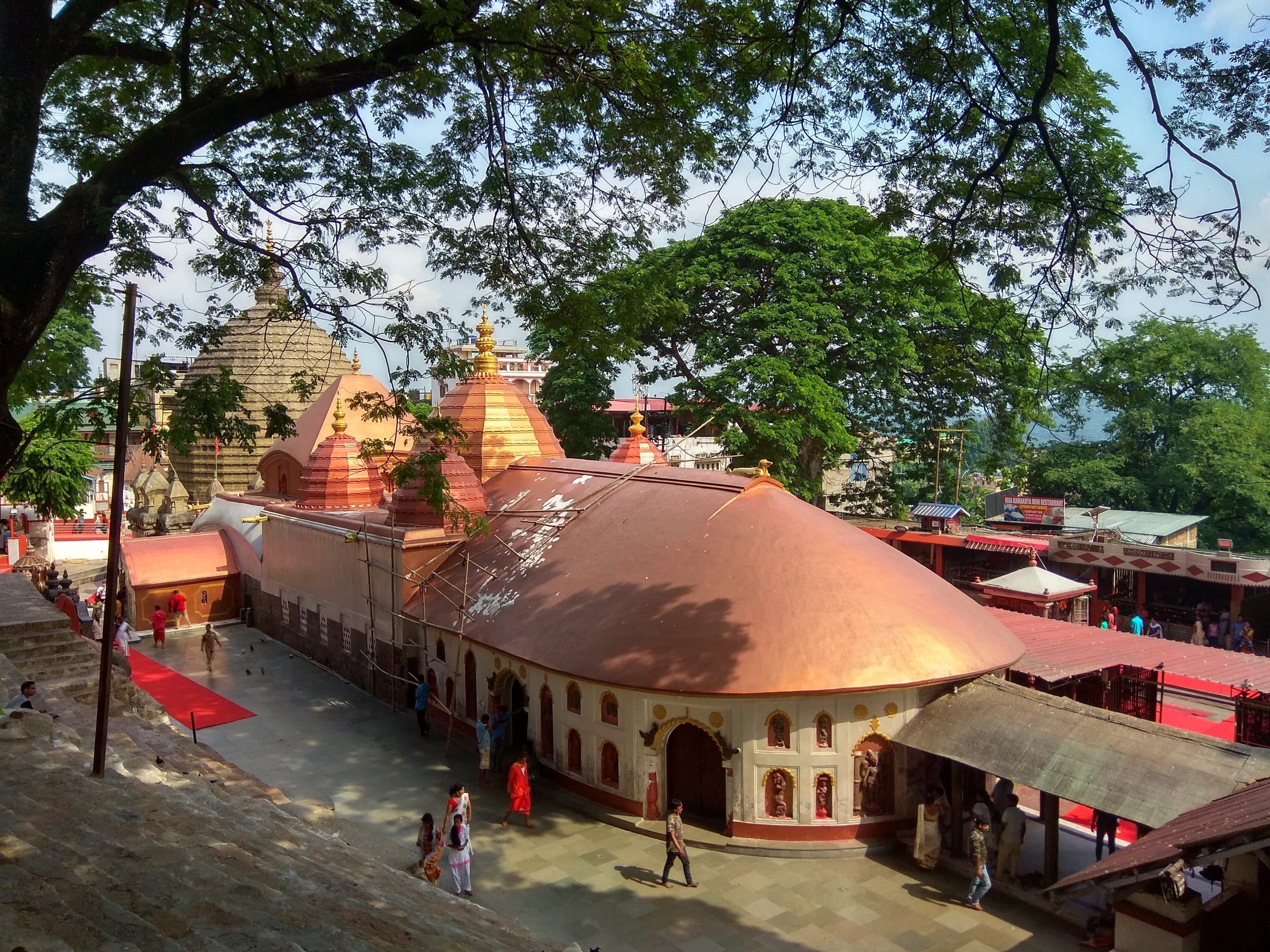
The standing temple that rises over that cave is a distinctive thing in Indian architecture. It is a fusion its builders improvised on the hill. It runs west to east as a sequence of four chambers. First comes the sunken garbhagriha that holds the yoni-rock. Then a square calanta hall, then the pancharatna, and finally a long natamandira, the assembly hall, with an apsidal end. Over the sanctum rises the feature that names the type. This is a hemispherical, beehive-like dome on a cruciform base. It is ringed by smaller turret-like angashikaras in the Bengal manner. The whole is built in brick above a lower band of stone. Tradition holds that the Koch artisan Meghamukdam achieved the brick dome only after two attempts in stone had failed. The result is neither the northern nagara tower nor a pure dome, and is known as the Nilachal style. Set into the outer walls of the natamandira are panels of carved stone reused from a much earlier shrine. This Kamarupa-period work carries the antiquity of the site back well beyond the visible building.
Destruction and rebuilding
The visible temple is comparatively recent. An earlier structure was destroyed during the sixteenth-century invasions from Bengal. This event was long attributed to the iconoclast general Kalapahar. Most historians now place it earlier, in the upheavals around Hussain Shah's invasion of the Kamata country at the close of the fifteenth century. The Koch king Naranarayan rebuilt the temple with his brother Chilarai and completed it around 1565. His father Biswa Singha is said to have rediscovered the ruined site and revived its worship. The rebuilding raised the hemispherical sikhara that survives in essentials today. Later Ahom kings took the goddess as a state deity, and added and embellished. The natamandira and its inscriptions belong to the eighteenth century, under rulers such as Rajeswar Singha and Gaurinath Singha. They also added the stone steps and subsidiary works that gave the hill the form a pilgrim sees now.
The sacred hill and its festivals
Kamakhya is not one temple but the chief of a cluster, for the whole Nilachal hill is sacred to the ten tantric wisdom-goddesses, the Dasa Mahavidya. Three of them are housed within the main temple and the other seven keep their own shrines up and down the slope, with sacred tanks and kunds between them, among them the Saubhagya Kunda where pilgrims bathe before worship. Among the ten stand Kali and Tara, and the fierce forms of Bhairavi, Chinnamasta, Dhumavati and Bagalamukhi, alongside Bhuvaneshwari, Kamala, Matangi and Tripura Sundari, their separate temples small beside the great sikhara, so that a full pilgrimage keeps to a sequence from tank to shrine to sanctum and the hill is read as one body of the goddess seen in ten aspects, a complete tantric landscape with Kamakhya at its centre.
The temple's greatest event is the Ambubachi mela of mid-June. The goddess is held to undergo her annual menstruation, and the doors close for three days. They then reopen to one of eastern India's largest religious gatherings. That rite sits alongside the animal sacrifice of the left-hand Sakta stream worshipped here, both bound to the myth of the goddess who bleeds.
The rest of the calendar is the node's own. Durga Puja brings the year's heaviest worship. The Manasa Puja in late summer is marked by the trance-dancing of the Deodhani. The Pohan Biya celebrates a symbolic marriage of the deity in the winter month of Pausha. The spring Vasanti Puja and the Madandeul observances round out a ritual year that keeps the hill in near-continuous festival.
Visiting
Kamakhya sits atop the Nilachal hill on the southern edge of Guwahati. It is some eight kilometres from the city's railway station and about twenty from the airport at Borjhar. It is reached by a winding road up the hill, or, for the able, a long flight of pilgrim steps. It opens daily to worshippers and visitors from the early morning, and typically closes around midday for the goddess's rest before reopening in the afternoon, though the hours are worth checking before a visit. On ordinary days the queue for the descent into the garbhagriha runs an hour or two. On auspicious days, at Durga Puja, and during Ambubachi it can stretch far longer. A faster paid-darshan line is usually available. Pilgrims commonly bathe in the hill's tanks first. Offerings of flowers, vermilion, and sweets are sold along the approach. The prasad and the red angabastra cloth are the things most carry away. Photography is restricted around the inner sanctum, and during part of Ambubachi access is closed entirely. The cluster of Mahavidya shrines across the hill, and the wide view over the Brahmaputra, are themselves part of the visit. They reward the pilgrim who does not stop at the main temple alone. Kamakhya is the chief of a wider ring of Guwahati shrines, and a fuller pilgrimage takes in the island temple of Umananda mid-river, the Navagraha temple of the nine planets on its own hill, and the hot-spring shrine of Basistha on the city's edge.