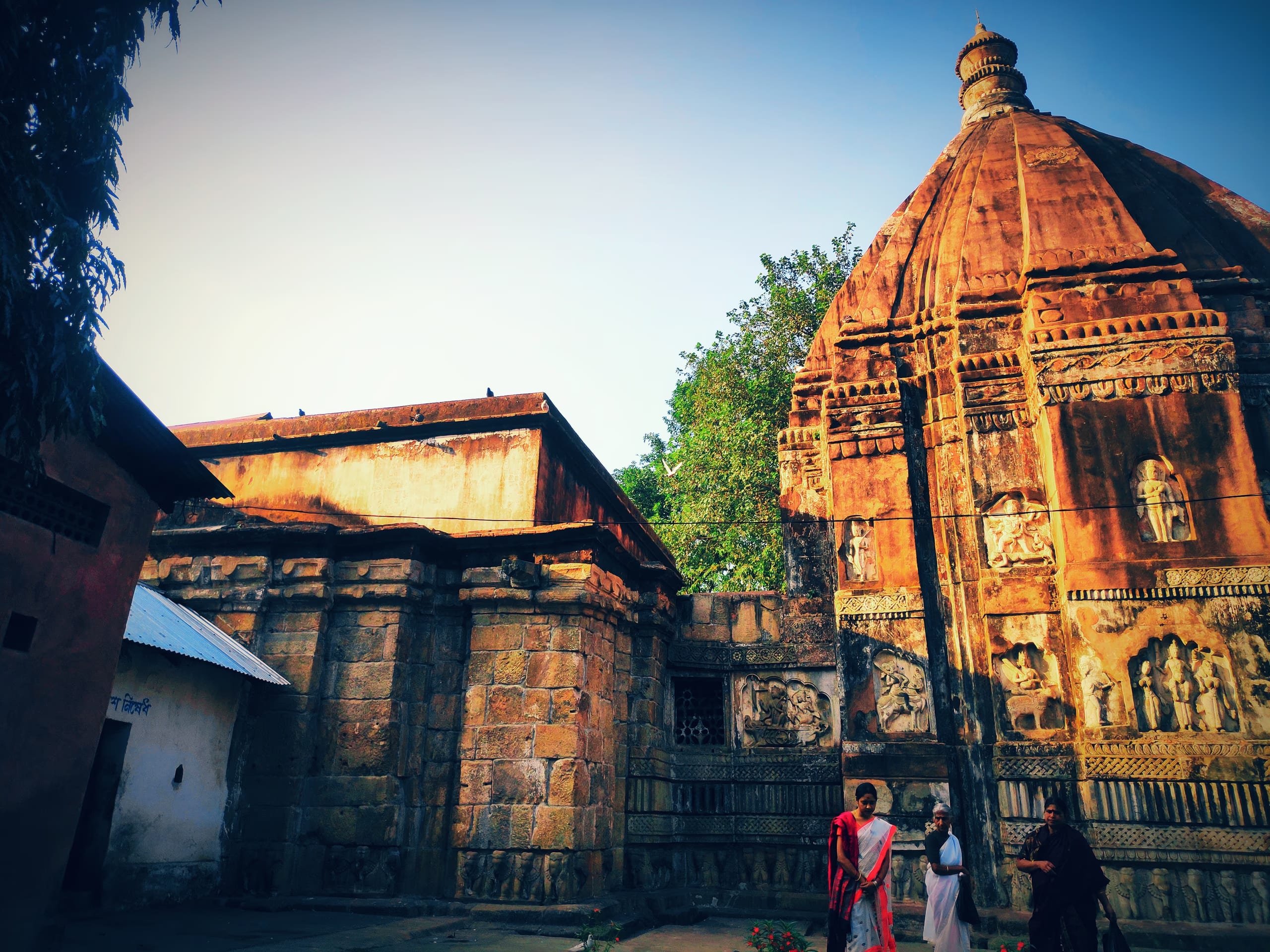
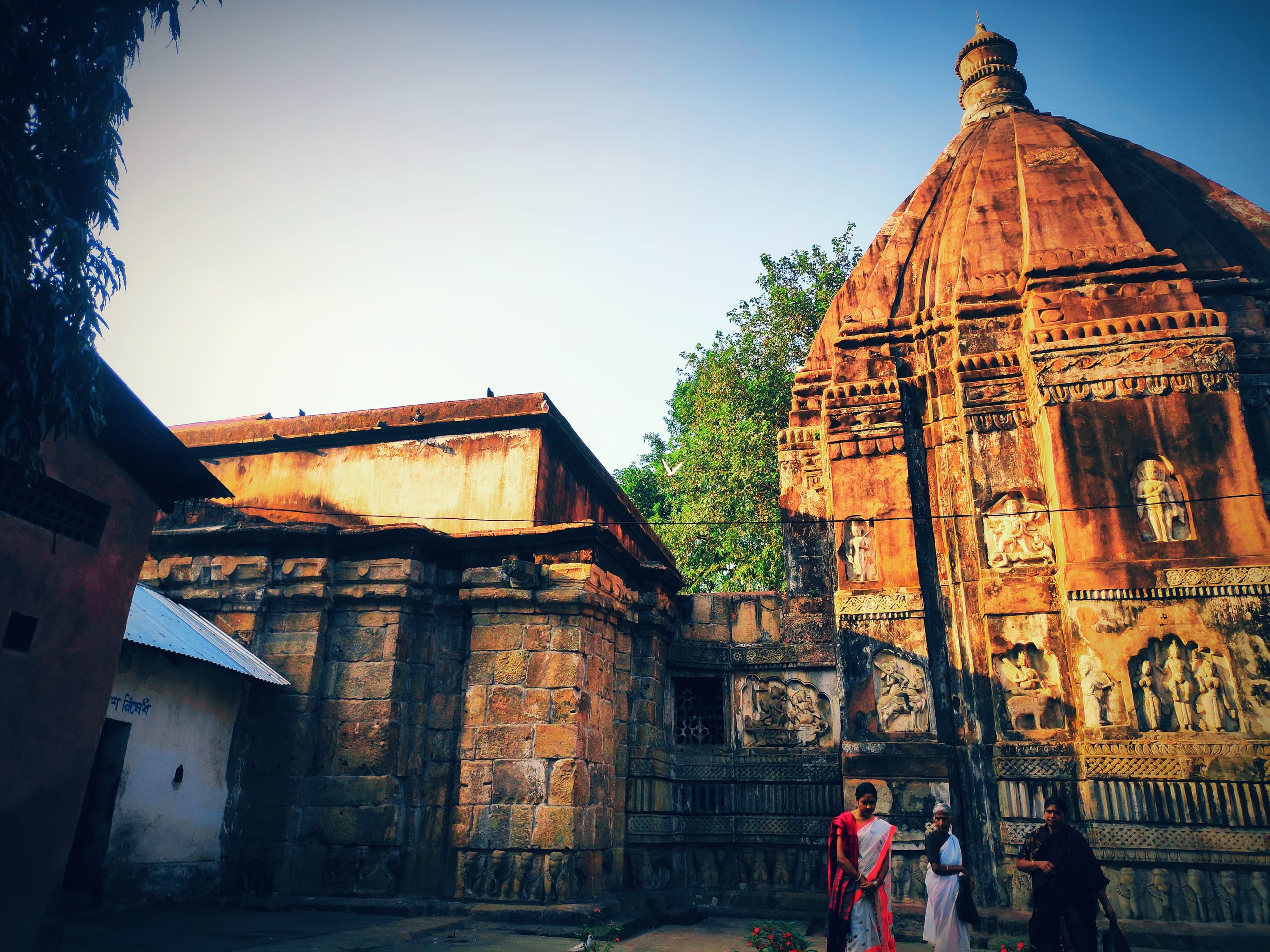
Hajo is one of the rare places sacred to three religions at once. They cluster on and around a low ridge near Guwahati. Here stands the Hayagriva Madhava temple, revered by Hindus and by some Buddhists. Beside it is the Powa Mecca, an important Muslim shrine. Nearby stand the Kedar temple and other shrines. This concentration of faiths makes Hajo a unique site of the valley's religious syncretism.
The Hayagriva Madhava temple
The principal shrine is the Hayagriva Madhava, a stone temple dedicated to a form of Vishnu, set on the Manikut hill. The site is ancient. The present temple is generally attributed to reconstruction under the Koch king Raghudeva in the late sixteenth century, on a foundation reaching much further back. The deity gives the shrine its name: Hayagriva, the horse-headed form of Vishnu, worshipped here as Madhava. The image in the sanctum is a dark stone figure, and the daily rites of a living Vaishnava temple continue around it.
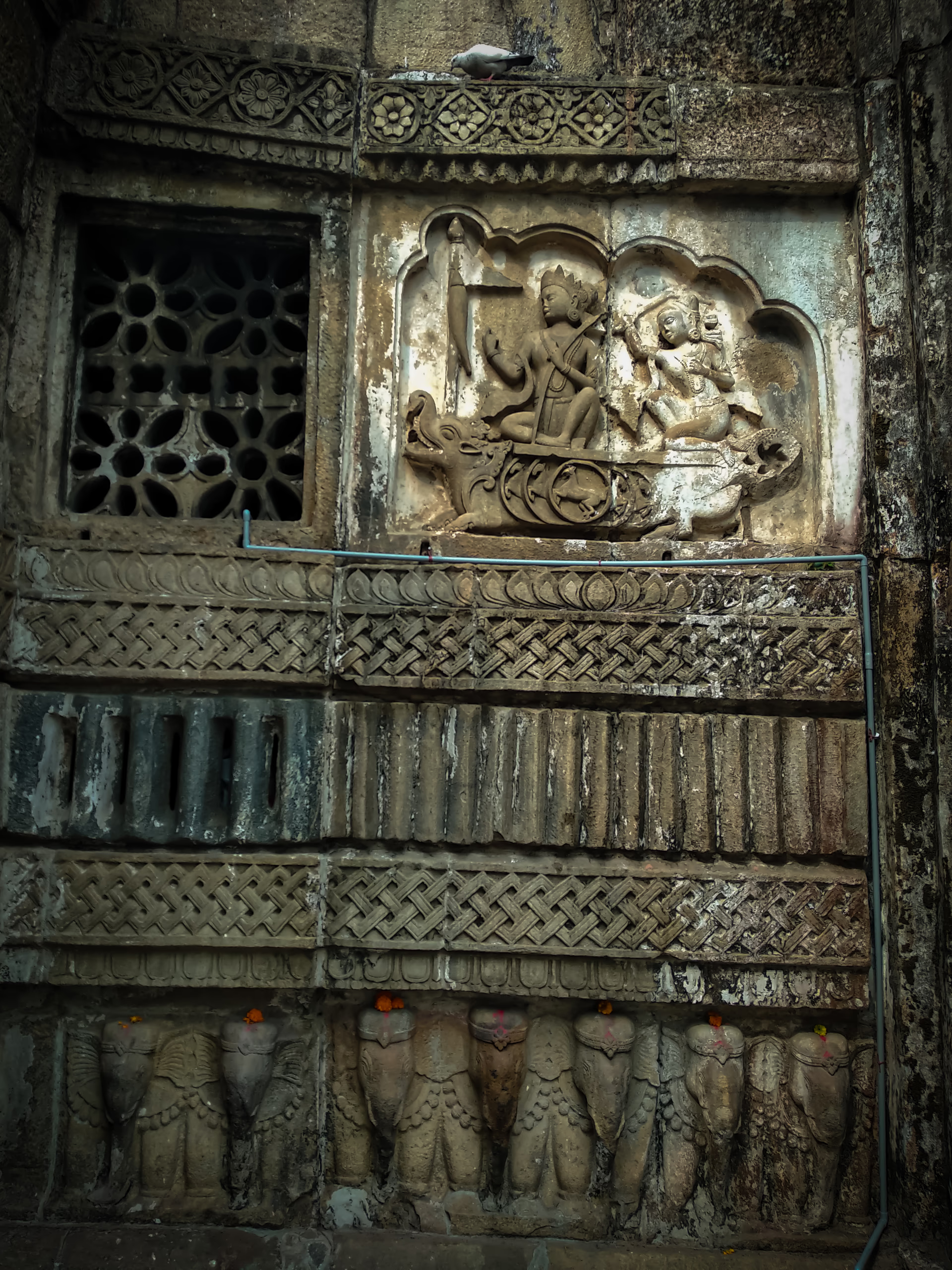
The building itself repays attention. It is reached by a long flight of stone steps up the Manikut hill, and its outer walls carry bands of carved stone. Among the reliefs devotees point out figures read as the ten avatars of Vishnu. A strong local tradition holds the shrine to be a place of Buddhist sanctity as well. It draws Buddhist pilgrims who venerate it in connection with the Buddha. This is one of the threads that gives Hajo its multi-religious character.
The Powa Mecca, and three faiths on one ridge
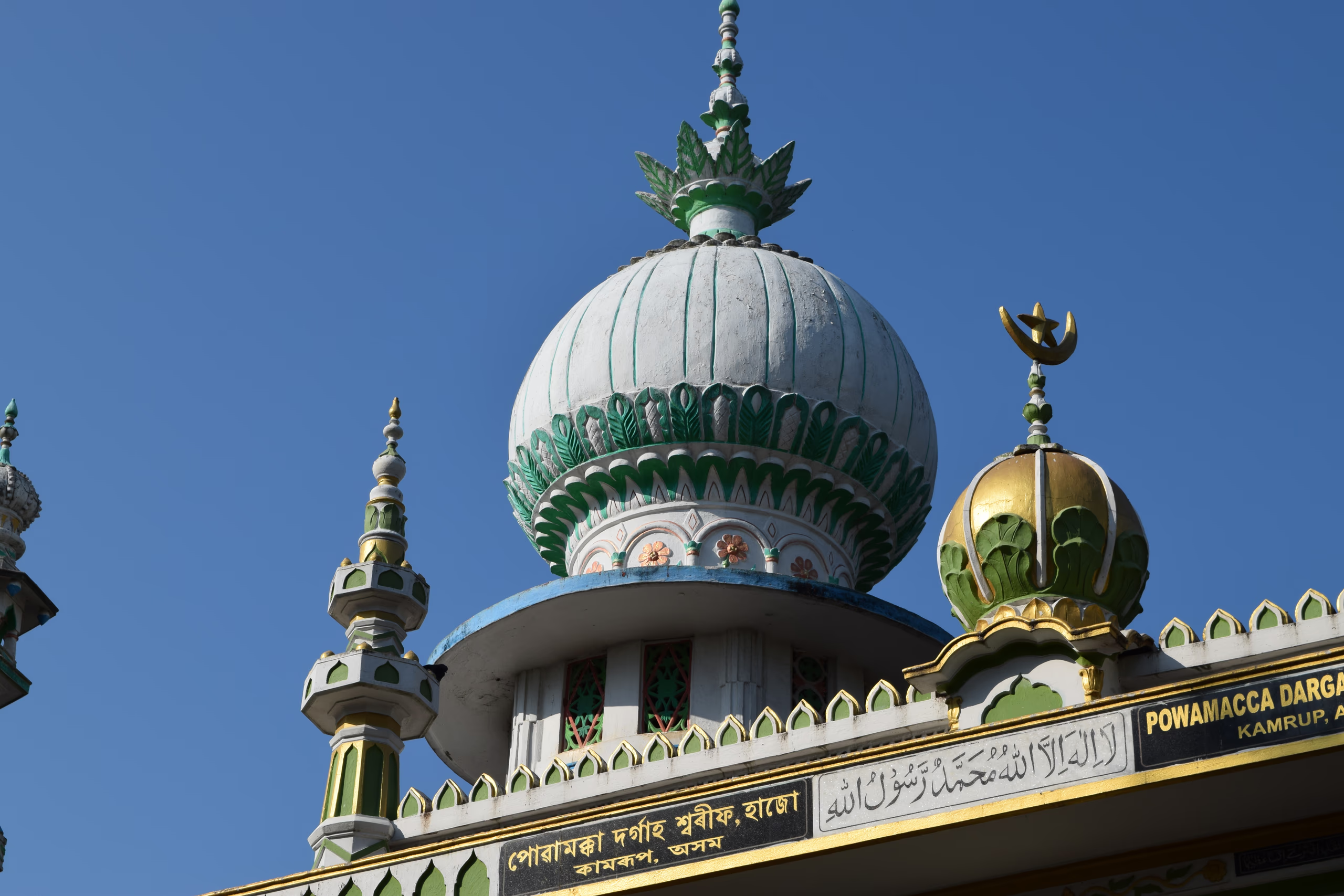
On a neighbouring rise stands the Powa Mecca, a Muslim shrine and mosque associated with the saint Pir Giyasuddin Auliya. It is held in great reverence by the valley's Muslims. It belongs to the Sufi-rooted, distinctively Assamese Islam whose spirit the tradition of Azan Fakir best expresses. The name is conventionally read as “a quarter of Mecca” in sanctity. It expresses the shrine's standing as a major centre of pilgrimage. The Powa Mecca stands beside the Hindu and Buddhist shrines, and that is what makes Hajo so striking an emblem of the region's layered religious life.
That layering has a long history. The Manikut hill was a sacred place of old Kamarupa centuries before the present temples. It was one of the ring of shrines that gathered, like Kamakhya across the river, in the gravitational field of the early kingdom's religious capital. The Vishnu worship of the Hayagriva Madhava is layered over far older devotion. The Buddhist thread is the most remarkable. A strong tradition, held especially among the Buddhists of Bhutan and Tibet, identifies the Hayagriva Madhava shrine as a place where the Buddha entered final nirvana. For centuries, Bhutanese pilgrims have come down from the hills to worship at Hajo, treating the Hindu temple as one of their own holy places. The Muslim sanctity of the Powa Mecca grew up on the neighbouring rise within the same sacred field. The result is the rarest of things. A single small ridge holds three great religions holy.
What sustained this coexistence was patronage as much as piety. Hajo lay near the western frontier where the powers of the valley met. Its shrines were endowed in turn by several powers. The Koch kings rebuilt the great temple. The Ahom court that later held the country gave its support. So did the Muslim rulers and nobles who honoured the Powa Mecca. Each dynasty added to a sanctity none could claim alone. In this region, a distinctively Assamese Islam grew up alongside the Bhakti devotion of the temples, carried by Sufis like Azan Fakir. Hajo became the physical emblem of that shared ground, a single ridge where three great traditions kneel.
Hajo's sanctity is not a single act of foundation. It is the accumulation, over centuries, of the devotions of several traditions on one sacred ground, Hindu, Buddhist, and Muslim. Successive rulers and peoples patronised it. It stands as the clearest single monument to the religious layering of the valley. Its sacred history is one of coexistence as much as of distinct traditions.
Other shrines and the setting
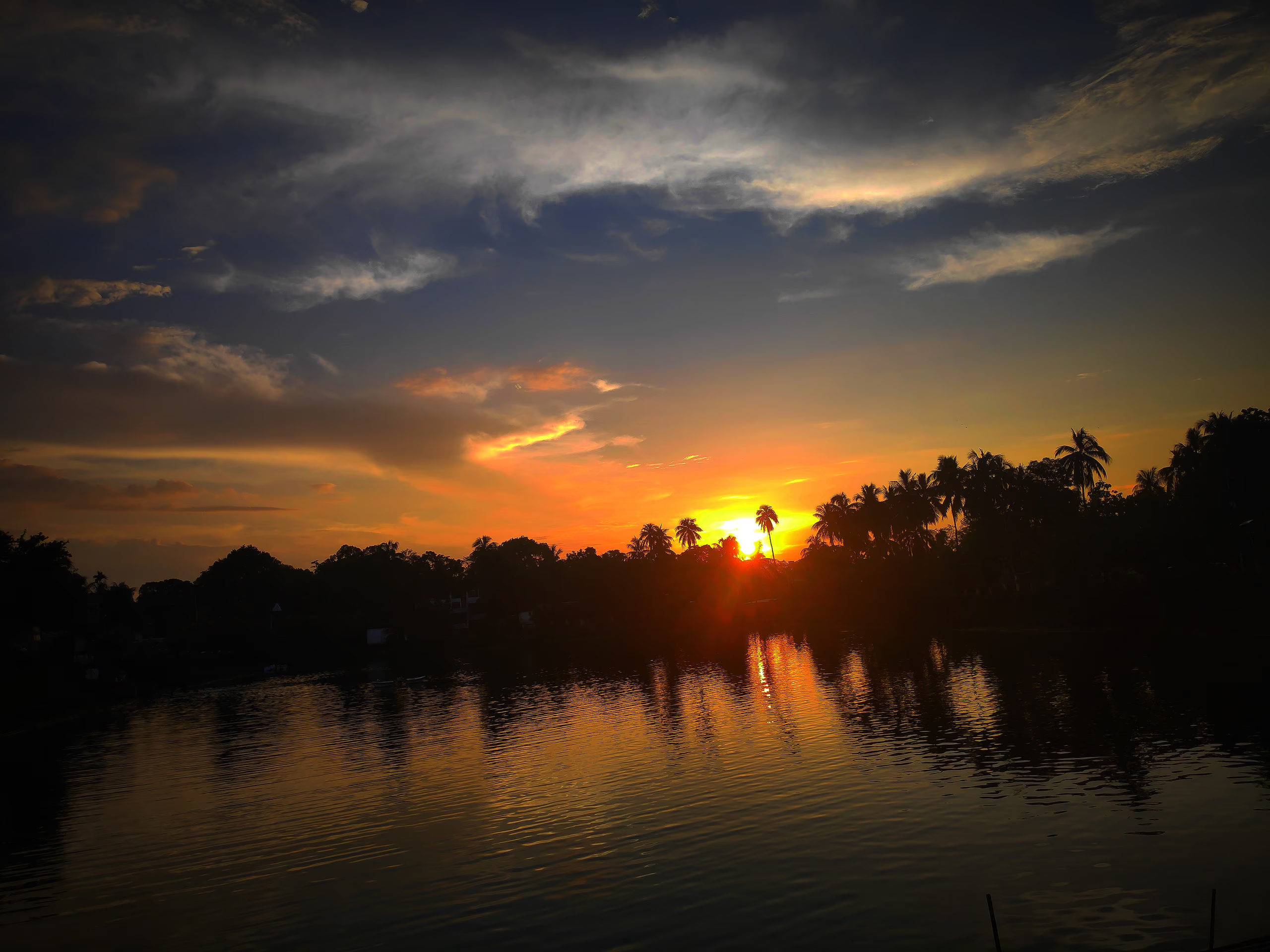
Around the two principal shrines the Hajo ridge carries further temples and tanks. The best known is the Kedar temple, a shrine of Shiva that stands on its own low hill a short way from the Hayagriva Madhava. Its sanctum holds a stone linga, and it draws Saiva worship to a ridge more often described for its Vaishnava and Muslim shrines. Between and below the temples lie sacred tanks, whose still water carries the reflection of the buildings and gathers pilgrims for ritual bathing. So the same short walk that links a temple of Vishnu to a Sufi dargah also passes a shrine of Shiva.
The whole site sits in the old Kamarupa heartland, not far from Guwahati and the Brahmaputra. It is a sacred landscape rather than a single monument, a cluster of hills and tanks rather than one building. That spread is part of what let so many traditions take root here: each found its own rise or court on the ridge. The long patronage of the Koch, the Ahom, and other rulers wove this landscape into the political history of the western valley as much as its religious life.
A pilgrim calendar shared across faiths
What gives Hajo its character on the ground is its calendar. The ridge is busiest not on the holy days of one community but on those of several, in turn, through the year. The Hayagriva Madhava draws its largest gatherings at the spring Doul festival and through the Vaishnava observances of the warm months, when the stone courts fill with pilgrims. The Powa Mecca keeps its own cycle. Its annual commemoration of the saint brings Muslim devotees up the neighbouring rise. The ordinary weeks between belong to a steady local traffic moving between the shrines. The same short walk carries a visitor from a temple of Vishnu to a Sufi dargah. Across the year, it carries them through the festivals of three communities. So the coexistence for which Hajo is famous is visible in its crowds as much as in its stones.
On the road to the hills
Hajo's sanctity was bound up with its geography. It stands on the north bank, not far from the old crossings of the Brahmaputra. It lay on the routes that ran north toward Bhutan and, beyond, the Tibetan plateau. That position shaped its devotion as much as its faith did. Those northward roads carried trade and tribute as well as pilgrims. The endowments of the Koch and Ahom courts kept the shrines maintained as much for their standing on a contested western frontier as for their holiness. So the temple and the dargah were objects of statecraft as well as of worship. To stand on the Manikut hill is to look out over a landscape that was at once a religious centre and a border. The layered devotion of Hajo is, in part, the record of who held that frontier, and honoured its gods, across the centuries.
Visiting
Hajo lies a short drive northwest of Guwahati and is easily seen in a half-day. A visit takes in both the Hayagriva Madhava temple and the Powa Mecca on their adjacent hills. Both are active places of worship, to be visited with the usual observances. The site is busiest on Hindu and Muslim festival days, when its three-faith character is most visible. It pairs most naturally with the silk-weaving town of Sualkuchi a little downstream on the same north bank. The two make a single north-bank day of the sacred and the woven. A visitor based in Guwahati can also set Hajo's shared ridge against the great Sakta hill of Kamakhya and the river-island shrine of Umananda across the water. These are three quite different faces of the valley's devotion within one short circuit.