Dakhinpat is one of the four great royal sattras of Majuli. It is a Brahma-samhati monastery, founded under Ahom patronage in the mid-seventeenth century. It is famous above all for its Raas Mahotsav, the autumn festival of the life of Krishna, for which pilgrims and visitors come to the island in their thousands. Its history is bound up with the throne that made it, its worship keeps the richer, more ceremonious temper of its order, and its headship has descended in the founder's own blood, unbroken, for more than three centuries.
A royal foundation
Dakhinpat was established around 1654 by Vanamalideva, a disciple of the preceptor Vamshigopal, under the patronage of the Ahom king Jayadhwaj Singha. This was the very reign in which the Ahom court had itself taken to Vaishnavism, and it was the same wave of royal endowment that founded Auniati. That wave made the sattras of Majuli institutions of the kingdom as much as of the faith. Grants of land and of paiks, the dependants assigned to work it, gave the sattra not only a site but a revenue and a body of labour, and made its satradhikar a figure of standing in both religious and worldly affairs.
The bond of throne and monastery ran deeper here than land alone. Later Swargadeos, among them Chakradhwaj Singha and Udayaditya Singha, are remembered in the sattra's own tradition as disciples of its head, so that the king who endowed the house also knelt before its guru for initiation. A tie of that kind cut both ways: it gave the sattra the protection and the wealth of the crown, and it gave the crown a share in the sattra's religious authority. Dakhinpat is reckoned one of the four great Chari-Raj or royal sattras of the island, named in the same breath as Auniati, Garamur and Kuruabahi, the small circle of houses the throne endowed and protected and, in turn, leaned upon.
To this day the sattra keeps a rite found at few other houses: the Brahmaputra Puja, a worship of the great river performed once every twelve years. It is a telling observance for a house on Majuli. The river that the sattra honours in that twelve-yearly rite is the same river that has taken so much of the island's ground, and the puja holds together, in a single act of worship, both the giving and the taking of the water on which the whole island lives. That such a rite should survive here, and on so long a cycle, is one measure of how old and how settled the institution is.
The home of the Raas
Dakhinpat is most renowned for its observance of the Raas, the dramatised retelling of the life and dances of Krishna staged over several nights in the autumn. The festival draws on the full neo-Vaishnavite repertoire of Borgeet song, Sattriya dance and bhaona drama, and it is among the most vivid times to see the living devotional culture of the island. This is the working liturgy of a monastery, not a show staged for visitors.
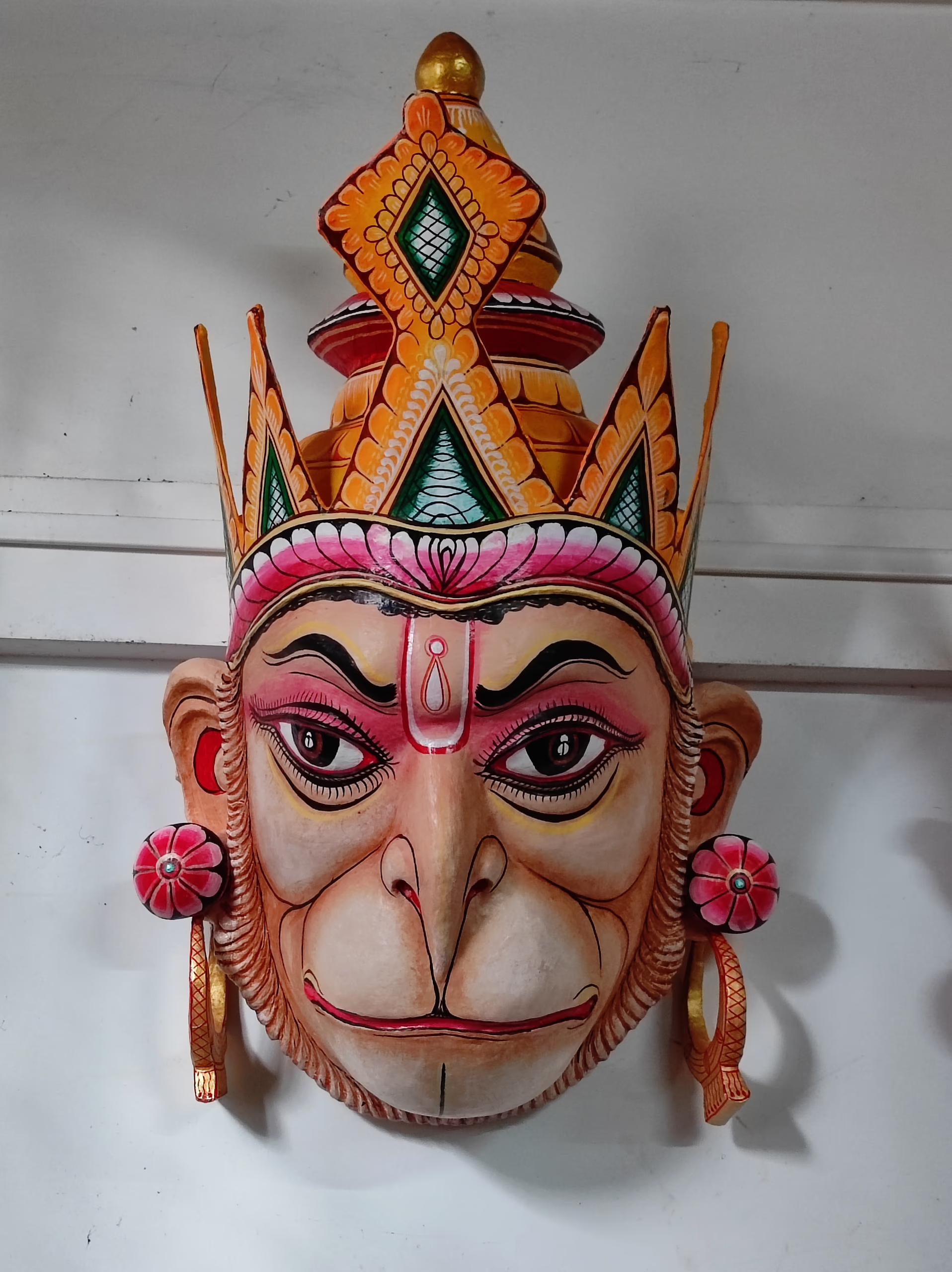
The Dakhinpat Raas is the grandest of Majuli's observances of the festival, and the one that draws the largest crowds across the ferry each autumn. Over successive nights the bhakats enact the whole cycle of Krishna's life on the Brindavan model: the birth, the childhood, the slaying of the demons and, at its heart, the raas-lila, the circling dance of Krishna with the gopis. It is carried in song, mime and dance, with painted effigies and the great masks of the tradition. The sattra's ordinary devotional means, the Borgeet, the Sattriya and the bhaona, are once a year gathered up into a single sustained act of worship that runs from dusk until the small hours. It turns the whole monastery into a stage and makes the festival nights the high point of its year.
The scale of the Dakhinpat Raas is of a piece with the temper of its order. Where the stricter, celibate houses keep their observances austere, the Brahma-samhati is the richer and more ceremonious of the four, and its festivals show it. The courts fill with pilgrims from across the valley and beyond; the effigies and masks are brought out; the nights run long. The reform that made theatre, song and dance the vehicles of a popular faith gave Dakhinpat its grandest rite. That reform began with Sankardev, whose songs and drama shaped the devotional life the sattra still keeps, and it is worth remembering, before the spectacle of the Raas, that its whole apparatus was devised not for display but to carry the stories of God to people who could not read them.
The Brahma-samhati order
Dakhinpat belongs to the Brahma-samhati, the most Brahmanical of the four orders, the samhatis, into which the movement divided after Sankardev and Madhavdev. This branch was founded by Damodardev. It moved away from Madhavdev's stricter line and readmitted much of the older ritual, the image-worship, the offerings and the observances of classical Hinduism, alongside the chanting of the name. Where the celibate orders founded from Madhavdev's line kept the altar bare but for the sacred book, the Brahma-samhati gives the worship of the image a central place beside the chant, keeps the Brahmanical calendar, and observes the older forms of temple service.
That doctrinal character shaped the kind of house Dakhinpat became. Its satradhikars were householders and men of property rather than cloistered monks. Vanamalideva, who founded it under Jayadhwaj Singha, was such a figure: a religious head whose monastery was at once a house of worship and an estate of the kingdom. The grandeur of the Dakhinpat Raas, the most lavish on the island, is in keeping with the richer, more ceremonious temper of that order, and so is the weight of ritual, offering and observance that fills the sattra's year between festivals. To understand Dakhinpat is to understand that it stood, from the first, on the wealthier and more worldly side of a movement that had begun as a reform against exactly such things, and that this was not a betrayal of the faith but one of the several forms the faith took as it settled into institutions.
The line of Vanamalideva
The headship of Dakhinpat has stayed, without break, within the family of its founder. By the sattra's reckoning, Vanamalideva lived a long life from 1576 to 1683, and he set the rule by which the line has descended ever since. The satradhikar himself observes celibacy, but one of his brothers is permitted to marry, so that the succession passes down the founder's own blood from one generation to the next. It is an ingenious device, and a characteristic one for a Brahma-samhati house: it keeps the sanctity of a celibate head while securing an unbroken hereditary line, and it marks the sharp difference between such a house and the wholly celibate sattras, where the succession passes from guru to chosen disciple and no blood descends at all.
The pontiffs who have held the seat across more than three centuries all trace their descent to Vanamalideva by this means. It is an unusually clear and continuous dynastic line for a religious house, and it is part of why Dakhinpat carries the weight of a settled institution as much as of a shrine. The chain of named heads, kept in the sattra's own records, is the human spine of its history: the run of men who held the worship, the estate and the great Raas in trust, one after another, since the seventeenth century. A line so kept is itself a kind of inheritance, and it has held through the loss of ground and the shifting of the island that would have scattered a lesser house.
The shape of the monastery
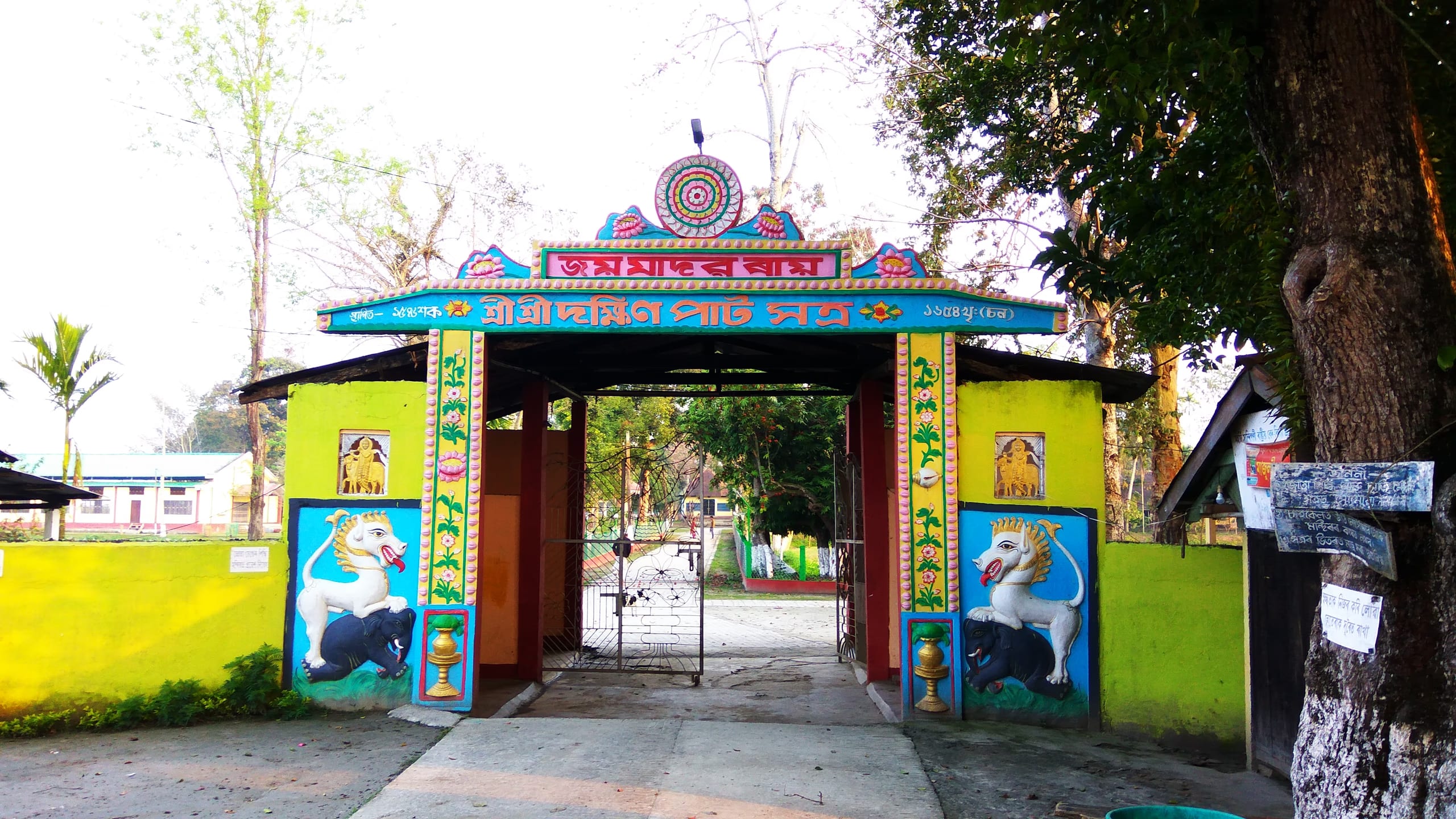
A Majuli sattra is built to a settled plan, and Dakhinpat shows it at its fullest. At the centre stands the namghar, the great pillared prayer-hall where the congregation gathers for the daily worship. At its eastern end is the manikut, the sanctum that holds the sacred text and image, the focus of the prayer. Around this core run the rows of hatis, the lanes of small cells in which the bhakats live, and the whole is entered through the batchora, the ceremonial gateway. The enclosure forms a small devotional town rather than a single temple.
To walk through it is to read the institution in its architecture: the hall for the gathered faith, the sanctum for the word, the cells for the lives given over to it, all set within one wall. This is the form the neo-Vaishnava reform gave to a community organised wholly around worship, and Dakhinpat keeps it on the ample scale its royal endowment allowed: a broad namghar, a deep manikut, and long rows of hatis that housed a sizeable body of bhakats. The open ground before the prayer-hall gives the room the Raas requires, and at festival time those courts fill exactly as the architecture intended. The visitor who comes then sees the form and its purpose meet, the built monastery and the living rite made for one another.
Within those walls Dakhinpat preserves manuscripts, ritual objects and the memory of its royal endowment, and it has carried the daily round of worship, prayer and instruction unbroken for over three centuries. That continuity has been hard-won. Like every house on the island, the sattra has lived its whole life inside the slow attrition of the Brahmaputra, and the wider account of that erosion belongs with Majuli's own article. What belongs here is that the plan, the line and the great Raas have all been kept against it, so that the monastery a visitor walks through today is not a survival by luck but a thing held in trust, deliberately, generation after generation.
Visiting
Dakhinpat lies on Majuli, reached by the ferry from Nimati Ghat near Jorhat and the island road. It is most worth visiting at the time of the Raas, when its devotional life is at its fullest and the courts before the namghar fill with the crowds the festival draws. It is an active monastery, to be entered with the observances proper to a place of worship. Pair it with the island's other royal sattras, Auniati and Garamur, and with Kamalabari, to read the full range of Majuli's monastic life in one circuit; and the cool, dry months from November to March are by far the easiest time to make the crossing.