Garamur is one of the four great royal sattras of Majuli. The Ahom court endowed this monastery, and it became, and remains, one of the leading cultural and administrative centres of the island. It stands close to the modern town that shares its name, and of all the royal houses it is the one that has turned its devotional life most openly toward the world beyond its walls.
A royal foundation
Garamur was established in the seventeenth century. By tradition its founder was Lakshmikantadeva, and it was built with Ahom patronage, belonging to the same wave of royal endowment that founded the other great sattras of Majuli. That wave made them institutions of the kingdom as much as of the faith. Like its sisters it belongs to the Brahma-samhati, the order that readmitted much of the older Brahmanical ritual alongside the chant, and it carried the tradition of Sankardev and Madhavdev forward through a resident body of bhakats under its satradhikar. The grants of land and dependants it received made it one of the wealthier and more influential of the royal sattras of the neo-Vaishnavite faith, and its head a figure of standing in both the religious and the worldly affairs of the late kingdom.
What set Garamur apart from the first was where it stood. It lies beside the chief town of the island, the settlement that took the sattra's own name, so that it sits at the meeting of the island's devotional and everyday life. The monastery and the town are so bound together that the one cannot well be visited without the other, and the market, the offices and the gatherings of Majuli have grown up around the sattra's own ground. A great royal house set at the civic heart of the island rather than in monastic seclusion was bound to live differently from its sisters, and Garamur has: its whole history turns on that openness to the common life around it. And like its sisters it has lived through the long erosion that has reshaped the island, an attrition it has met, as will be seen, from an unusually exposed and unusually rooted position.
The sattra is in fact two houses, Garamur Bor Satra and Garamur Saru Satra, the greater and the lesser. Both keep the old relics and both stage the Raas, so that the inheritance is carried in a pair rather than a single establishment. It is a division of the kind that appears more than once in the history of the sattras, where a growing house threw off a second establishment without breaking the line, and at Garamur it has meant two centres of the same tradition standing side by side at the island's heart.
Relics and the arts
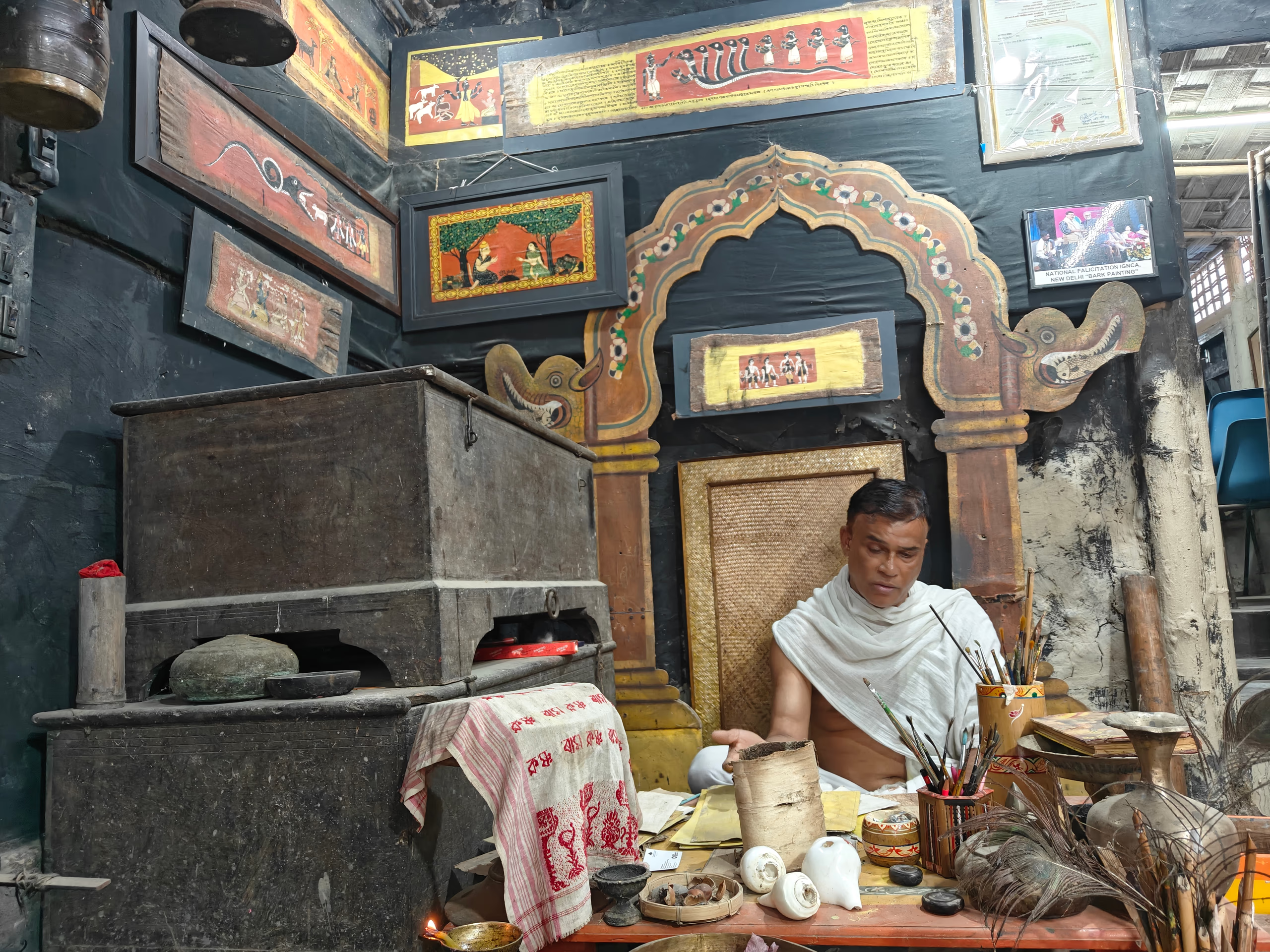
Garamur preserves manuscripts, ritual objects and relics of the Ahom period. The most remarkable of them are the ancient cannon, the bartop, held by tradition to be gifts of the Ahom kings. These are pieces of royal ordnance kept in a house of prayer, and they are a vivid token of how completely the throne and the sattra were bound together in the late kingdom. In those years the crown armed and endowed the monasteries, and the monasteries in turn lent it their religious authority. A cannon in a prayer-hall is a fitting emblem of that bargain, and of Garamur in particular: a house that has always reached past the purely devotional into the reform and the public life of the island.
Beside the ordnance the sattra keeps the manuscripts, the ritual vessels and the ceremonial goods that every great Majuli house guarded, and it has long been a centre of the performing arts of the tradition, the Sattriya dance and the devotional music and drama that the island's sattras have carried down. Its own Raas, the dramatised life of Krishna staged at the close of autumn, is among the island's most attended. That outward, boundary-crossing instinct, the readiness to carry its arts and its authority beyond the enclosure, is in its way a return to the first impulse of the faith. It echoes the popular reform that Sankardev set in motion, which had itself sought to carry the worship of God out of the temple and the Sanskrit text and into the language and the gathering-place of ordinary people.
A reforming sattra, set beside the town
Garamur is remembered, more than its sisters, as a sattra that reformed itself. In the early twentieth century its satradhikar Pitambardeva Goswami opened the monastic world outward. He took charge of the Garamur establishment in the first decade of the century and is reckoned among the most notable Assamese religious reformers of the age. He relaxed old exclusions and encouraged modern education, and he lent the authority of the sattra institution to social reform and to the national movement then stirring in Assam.
The significance of that turn is easier to see against what might have happened instead. A great royal sattra, wealthy and secure in the crown's old favour, might easily have hardened into a guardian of privilege and precedence, a keeper of exclusions. That some did, and that Garamur did not, was a choice, and it fell to a reforming head to make it. Instead of closing inward, Garamur turned its standing to the service of the wider society, lending its weight to the schools, gatherings and cultural institutions of the town that grew around it. A sattra that had begun as an instrument of the Ahom state thus became, in the colonial century, an instrument of Assamese social and cultural renewal, and it did so from within the tradition rather than against it.
This engagement, as much as its relics or its Raas, has kept Garamur central to the island. For a visitor, it makes Garamur the sattra in which the institution's public role, and not only its devotional one, is easiest to see. Where another house shows what a monastery is, Garamur shows what a monastery can do in the common life of a people, and that, in a tradition founded as a popular reform, is not a departure from its purpose but a fulfilment of it.
A heritage carried, not merely kept
What sets Garamur's inheritance apart is less what it holds than what holding it has cost. Every house on Majuli has lived its whole life inside the slow attrition of the Brahmaputra. Against that, the survival of Garamur's royal cannon, its manuscripts and its unbroken Raas is not a thing simply handed down. It is a thing carried, kept by a community willing to move its treasures ahead of the water rather than lose them to it. The wider account of how the river is steadily eating the island belongs with Majuli's own article. What belongs here is what that long pressure has made of this one house: a sattra whose relics are proof less of good fortune than of refusal.
On much of the island the refusal did not succeed, and houses have been moved, and moved again, or lost. That it succeeded here owes something to where Garamur stands. Alone among the great royal houses, it sits not in monastic seclusion but at the civic heart of the island, beside the chief town that grew around it. So the monastery has never been a thing apart from Majuli's common life; it has been bound up in its offices, its market and its gatherings. A house so placed is harder to abandon and easier to rally to, for its survival is the town's concern and not the brotherhood's alone.
The same public, outward temper that made Garamur a centre of reform has thus helped keep it, against the river, one of the living centres of the island rather than one of its losses. The two things are of a piece. A sattra that had turned outward to the society around it had, in that society, a constituency that turned back to it when the water came, and the openness that shaped its history in the calm centuries has been, in the century of erosion, a part of how it has endured at all.
Visiting
Garamur lies near the main town of Majuli. It is reached by the ferry from Nimati Ghat near Jorhat and then the island road, and is among the more accessible of the sattras. It is an active monastery, entered with the observances proper to a place of worship. The autumn Raas is the most vivid time to come. A visit pairs naturally with the island's other royal houses, Auniati and Dakhinpat, and with the mask-making sattra of Samaguri a short way off. Carry the circuit on to the dance-and-music houses of Kamalabari and Bengenaati further along the island road, so that the dance, the manuscripts and the living crafts of the tradition can be taken in together over a day or two on the island.