Sualkuchi is a town of looms. It stands on the north bank of the Brahmaputra near Guwahati. It is the great weaving centre of Assam. Here the valley's golden muga and its other silks are turned into cloth on thousands of household handlooms. It is a craft town whose whole life is organised around the silk it produces.
A weavers' town by royal design
The origins of Sualkuchi as a silk town are traced, in the well-known tradition, to royal patronage in the medieval period. By one account it began with the Pala king Dharmapala, who is said to have settled weaver families there, drawing the scattered skill of the craft into one place under the crown's eye.
Whatever the precise founding, the town owes its character to a deliberate act rather than to slow accident. Weaving was practised in ordinary households the length of the valley, but what made Sualkuchi different was concentration. Successive rulers gathered weavers into it, and under the Ahom kings, who organised so much of the valley's craft labour into dedicated communities, that concentration hardened into a settled specialism. A town given over almost wholly to the loom could hold the finer skills, the tools, and above all the market that a true silk centre needs and that a single household loom cannot. Sualkuchi became the place where the valley's most demanding silk work was done, and where buyers knew to come for it.
The silks and the household loom
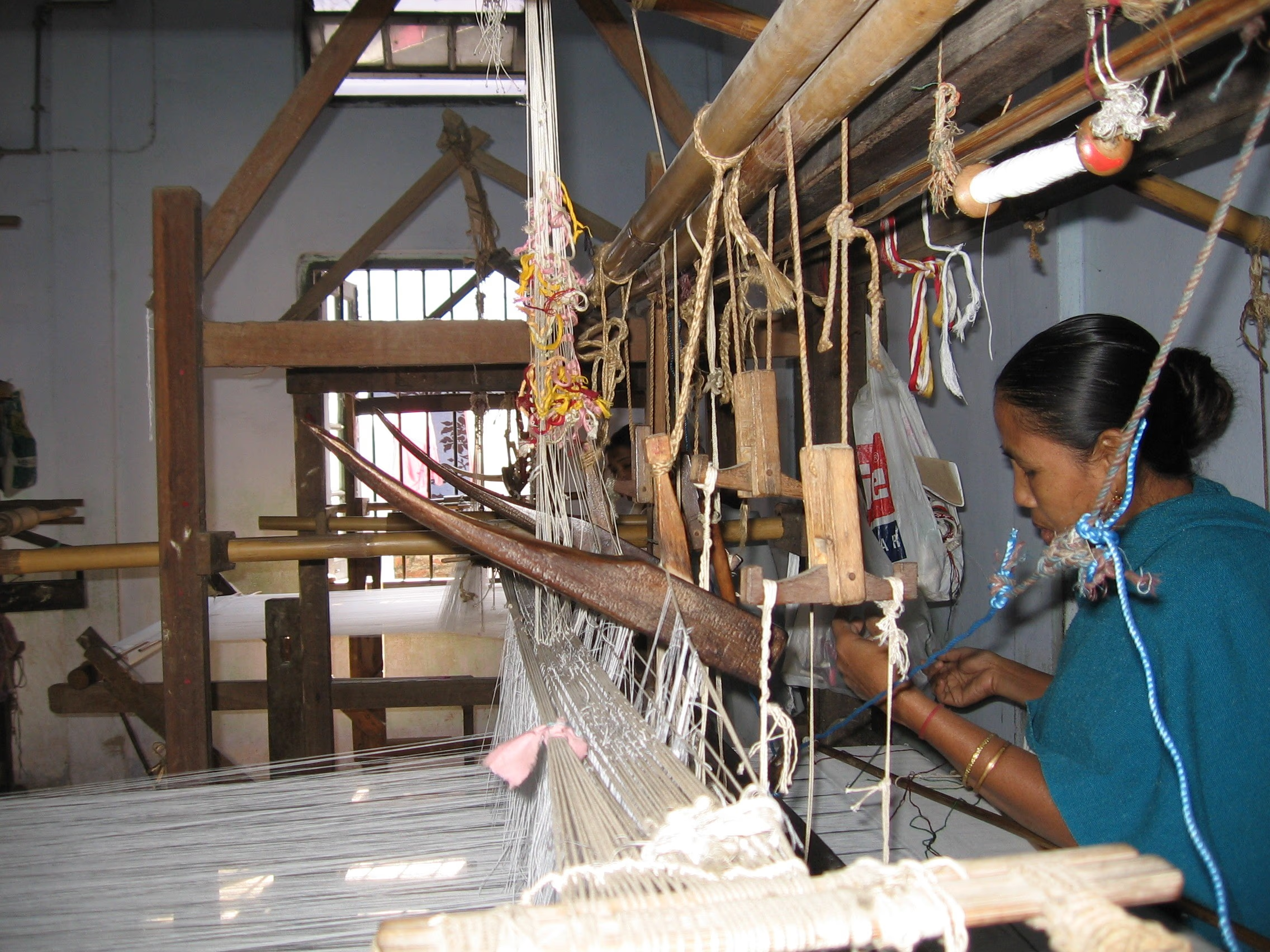
Sualkuchi works all three of Assam's silks: the golden muga, the warm eri and the white pat. They are distinct crafts. The golden muga is the most prized and most Assamese of them. It comes from the wild Antheraea assamensis moth, whose caterpillars are reared in the open on the som and sualu trees of the valley. This silk is found in commercial quantity almost nowhere else on earth. It is famous for a natural gold lustre that deepens, rather than fades, with washing and age. It is the foundation of the town's fame. The white pat, from the mulberry-fed silkworm, gives the finest and most formal cloth. The warm, matt eri, reared on the castor plant, makes the everyday shawls that carry a household through the cold months. Each silk demands its own long chain of labour before a single length is woven: the rearing, the reeling of the thread from the cocoon, the dyeing, and the dressing of the warp. Sualkuchi is the place where all three are brought together at scale. There they are turned into the mekhela-sador, the two-piece dress of the Assamese woman. It is often patterned with the woven motifs that are the signature of the town's looms, among them flowers, creepers and the lotus.
Weaving in Assam has long been a household art, famously practised by women across the valley. Sualkuchi concentrates that domestic tradition into a true silk town: looms in the home, the labour of the family, and a community whose social and economic life is woven, quite literally, around the loom. The loom is so deep in the culture that a woman's skill at it was long held to be a measure of her worth. Cloth woven by hand carried a meaning far beyond its use.
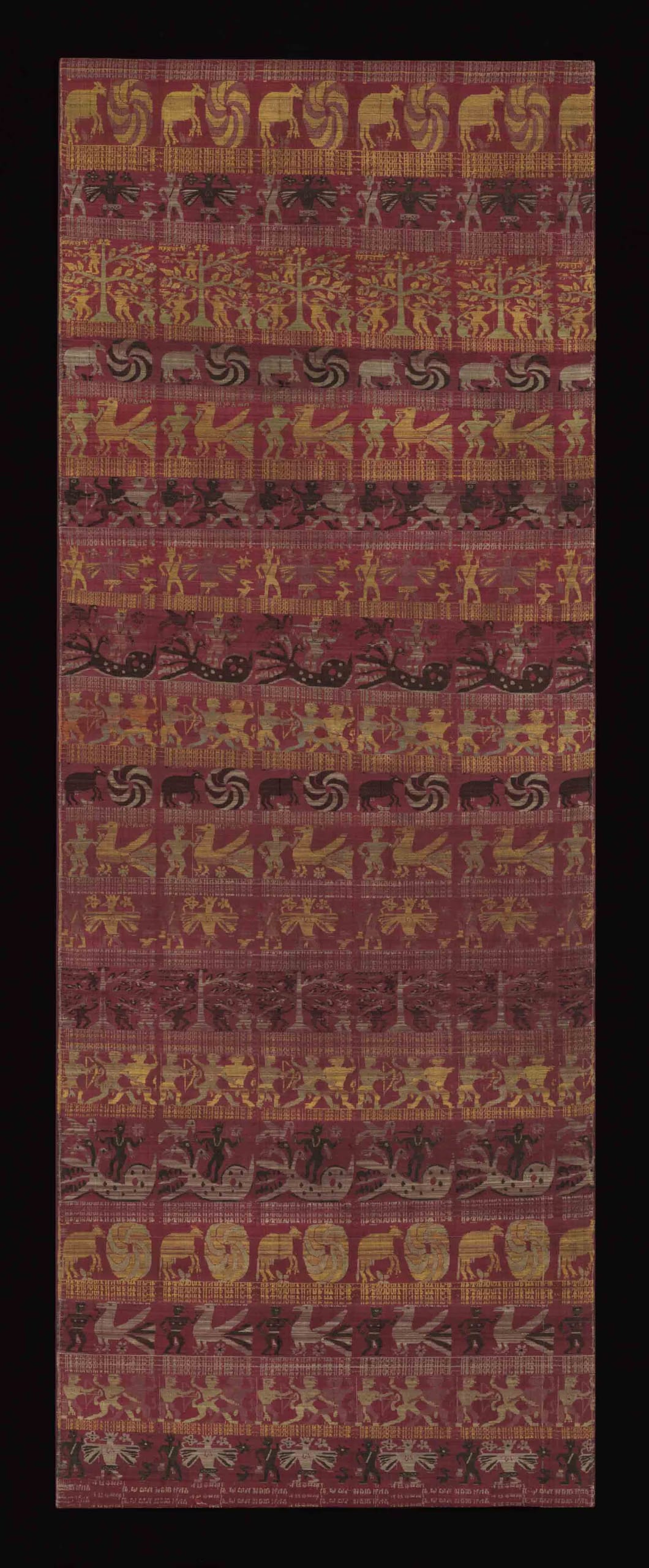
At its height this weaving art could attempt astonishing things. In the sixteenth century, under the direction of the saint Sankardev, Assamese weavers wove the whole life of Krishna into a single monumental silk, the Vrindavani Vastra. This masterpiece later vanished from Assam. It survives now only as fragments scattered across the world's great museums. It is the high-water mark of the very craft Sualkuchi keeps alive, and its strange, wandering afterlife is told as a story.
The Vrindavani VastraA saint set twelve weavers to weave the whole life of Krishna into one vast silk. It vanished over the Himalayas, was cut up by monks who could not read it, and ended scattered across the world's museums.Read the story →Nowhere is that meaning held more intensely than in the valley's most famous weaving legend: the tale of the kavach kapor. This was the armour-cloth a wife was held to weave for her husband in a single night, begun and finished before dawn, that would carry him unharmed through battle. The legend belongs to the wars of the old eastern kingdom rather than to this town. Yet it is the story Assam tells about what the loom could mean: the night's labour turned into protection, the cloth made an act of love and faith. It is woven into the same craft that Sualkuchi raised to its height.
Woven in a NightAn Ahom noblewoman could not weave her husband the armour-cloth that was held to make a warrior unkillable. When he fell, she armed a band of women and rode to the war herself.Read the story →How a silk town works
The making of a single mekhela-sador draws on a long chain of hands. In Sualkuchi that chain is the shape of the town. Before a length is woven there is the reeling and spinning of the thread, the dyeing, and the dressing and mounting of the warp. Then come the long days at the loom, where the throw-shuttle has given way over the last century to the fly-shuttle. At the end comes the finishing of the cloth. Households own a few looms each. Master weavers and small cooperatives organise the trade. A seasonal workforce, much of it drawn from elsewhere in the valley, swells the town in the wedding and festival months, when the demand for fine cloth is highest. The result is a place where almost every home gives onto a loom shed, and where the clack of the shuttle is the background sound of the streets. Weaving is not a craft pursued beside other work but the work itself, the axis of the town's economy and of its sense of who it is.
The Manchester of the East, and its pressures
Sualkuchi's modern fame rests on scale. The town concentrated the household art under the old kingdoms. Across the twentieth century it grew into one of the largest weaving clusters in the region. Its looms now number in the thousands, and its cloth is carried to markets across India and among the Assamese diaspora abroad. That output earned it the old epithet of the Manchester of the East, also rendered the Manchester of Assam. That scale brought both prosperity and exposure. Assam muga was registered as a geographical indication in 2007, among the first products of the state to win that status. The registration recognised the silk's unique origin and gave some protection against imitation. It was reinforced in 2014 by a distinctive GI logo to mark certified cloth.
Even so, the town lives under real and continuing pressure, as all of Assam's traditional crafts do. Cheaper power-loom cloth undercuts the handloom on price, the supply of raw silk is uncertain from season to season, and synthetic substitutes are sold as the genuine thread. Behind these is the hard economics of a slow, hand-made luxury competing in a fast market, the same test the muga moth's own dwindling rearing faces. Sualkuchi's identity is bound to the loom in a way few places' are, and its golden thread runs, materially, from the courts of the old kingdoms to the household handloom of today. Whether that thread holds is the open question of the town's future.
Visiting and buying
Sualkuchi lies a short distance from Guwahati on the north bank and can be visited in half a day. Many households and cooperatives welcome visitors to see the looms and buy directly. Genuine muga is costly and often imitated. So buy from a known weaver or cooperative, and ask about the silk's origin. That is the surest way to support the craft and avoid the substitutes.