The Talatal Ghar is the largest building the Ahom kingdom ever raised. It is a great multi-storeyed royal complex at Rangpur, near Sibsagar. It was palace, seat of government and fortress at once. It is famous as much for what lies beneath it as for what stands above. The name itself, tala-tal, means the floors below. It points to the subterranean storeys and passages that run under the visible palace. Much of the building’s legend has gathered around those hidden levels, and around the escape tunnels said to lead from them. More than any other surviving structure, it shows how an Ahom Swargadeo actually lived and ruled at the height of the kingdom.
When it was built, and by whom
The Talatal Ghar belongs to the era when Rangpur had become the Ahom capital. It grew by stages, not in a single campaign. Tradition begins the complex under Swargadeo Rudra Singha, who reigned from 1696 to 1714. He shifted the kingdom’s seat to Rangpur around 1707, and raised the upper palace. By the standard account, it was Rudra Singha who brought a master builder named Ghanashyam from Cooch Behar to lay out the new capital. The architect's hand is remembered across the royal works of Rangpur. His successors then enlarged the palace downward and outward through the kingdom’s golden age. That was the same span of confidence and revenue that raised the pleasure-pavilion of the Rang Ghar and the great temples of the Sibsagar tank. The heaviest brick additions, including the massive lower and underground storeys, are remembered under his son Rajeswar Singha, who ruled from 1751 to 1769. What began as a royal residence thus became, generation by generation, the working heart of the state. It was residence and treasury and arsenal together. Its scale was a direct measure of an Ahom monarchy that by now commanded the whole Brahmaputra valley. Rudra Singha, who began the palace, spent his last years preparing a great march on Bengal, a campaign his death left unlaunched.
The floors above and below
The complex is distinguished by its combination of upper storeys and underground levels. It is a palace several floors high, set over chambers and passages sunk beneath the ground. The popular account is precise about the count. It gives seven floors in all: four standing above the ground, and three driven beneath it. It is those buried storeys that give the monument its very name.
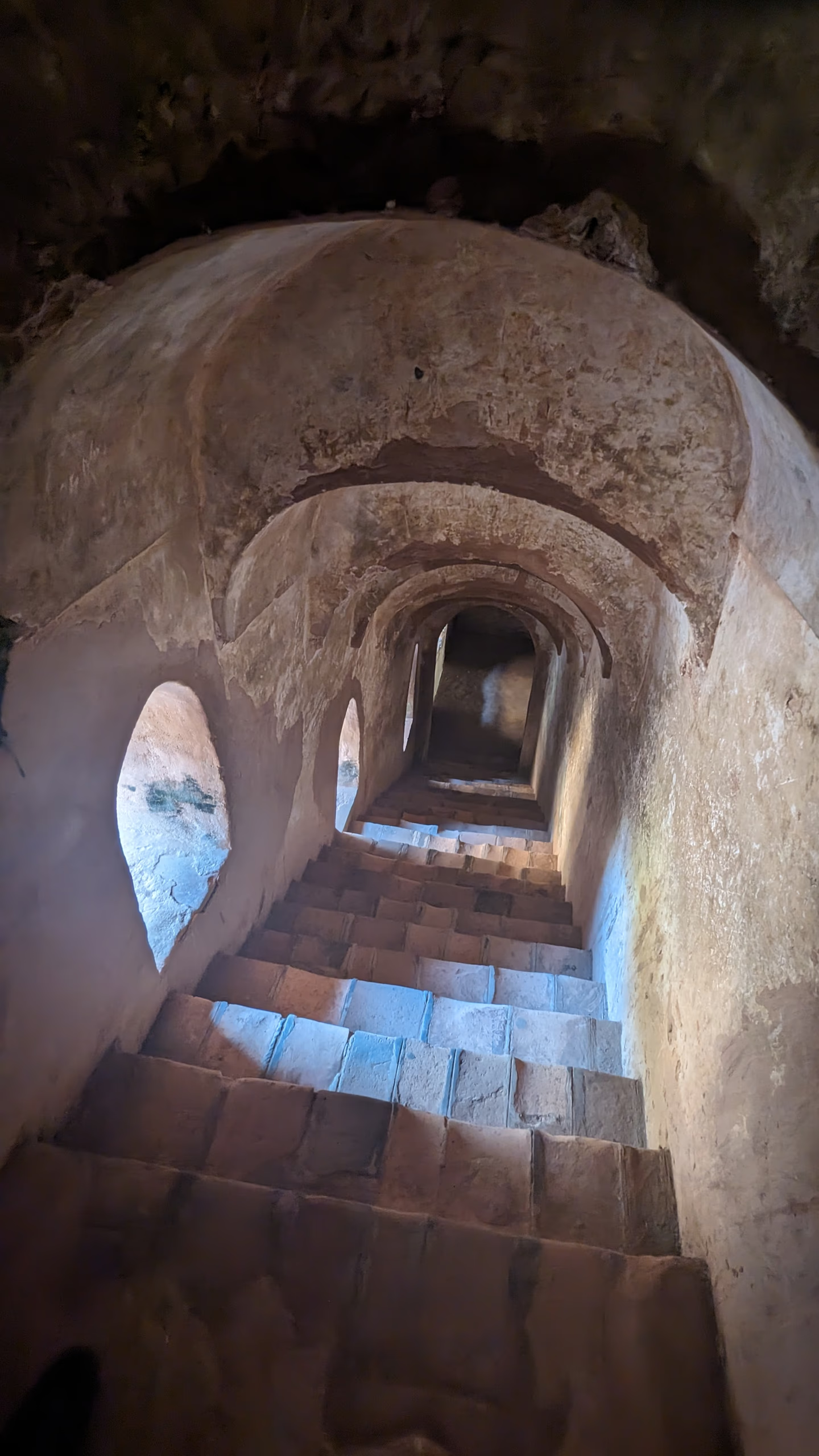
The visible building was of thin Ahom brick, laid in the masons’ indigenous organic mortar. It held the apparatus of a working court: the household, the administration and the garrison. The lower floors served for storage and for stabling. They also served the security of a court that had learned, in harder times, never to be without a way out. A persistent popular tradition holds that two tunnels ran from the complex. The shorter is said to run some three kilometres to the bank of the Dikhow river. A far longer one is said to reach some sixteen kilometres toward the older palace at Garhgaon. Both were dug as escape routes in case of siege. How much of that underground network truly survives, and how much is legend grown around sealed and collapsed chambers, the historians treat with proper caution. What remains, even incomplete, is the fullest picture we have of Ahom secular building. It is not a temple or a tomb, but the literal machinery of a kingdom’s government, rendered in brick.
The sheer scale of the thing is its other astonishment. It spread over a great walled compound, rising several storeys above ground and sinking several more below. The Talatal Ghar was the largest single building project the kingdom undertook. The labour of raising it fell, as all great Ahom works did, on the paik levy, the conscript service-guilds that supplied the kingdom’s masons, brick-makers and carriers. The walls were carried up in the thin, well-fired Ahom brick, laid in the indigenous organic mortar that the kingdom’s builders favoured over lime. The vaulted underground chambers were drained and ventilated to keep stores and stabling sound in a wet, flood-prone country. This was a feat of engineering as much as of architecture. The same craft that raised the temples and the Rang Ghar nearby turned to the harder problem of building downward into the floodplain.
A palace built for a war-state
The Talatal Ghar is best understood as the architecture of a kingdom organised for war. The escape tunnels, the defensible massing, the union of treasury and arsenal and garrison under one vast roof all belong to a state whose six centuries of independence rested on a military and naval machine. That machine is described in the war machine of the kingdom. It was a system of conscript labour and river fleets that had thrown back invasion after invasion from the west.
It was from a court housed in complexes like this that the Ahoms marshalled the forces that fought the Mughals to a standstill on the Brahmaputra. The decisive night of that campaign is told in the story below. The building carries, in its very plan, the watchfulness of a power that never took its survival for granted.
The Night of SaraighatA dying general, a wavering fleet, and the river that kept Assam free of the Mughals.Read the story →Survival and preservation
The Talatal Ghar stands today as a protected monument, conserved as the most important survival of Ahom secular architecture. It sits within the cluster of royal sites around Sibsagar and Rangpur, alongside the Rang Ghar, the Kareng Ghar palace at Garhgaon and the temples of the Sibsagar tank. Tradition holds that the three lower storeys were sealed and filled in during the British era. Much of the rest of the underground network has been closed or has fallen in. So only a part of the great complex remains above ground, and the visitor reads the building partly from what survives and partly from its plan. Yet even in that partial state it remains the grandest secular ruin the Ahoms left. It is the clearest standing evidence of the administrative and military reach of the kingdom at its height.
That the complex had extensive underground chambers is not in doubt. What remains uncertain is the famous tunnels, and here the archaeology is worth stating plainly. Excavations at the site in 2000 and 2001 uncovered buried structure of the ordinary kind that a great working palace leaves behind: brick platforms and pathways, walls, terracotta drains and potsherds. These confirmed the depth and substance of the lower complex. The tunnels themselves have proved harder to confirm. In 2015 the Archaeological Survey of India, working with IIT Kanpur, ran a ground-penetrating radar survey across the site. It was reported as among the first such surveys in the northeast. The instruments revealed no secret tunnel. That is not proof that none ever existed, since a passage long collapsed, filled and flooded can fade below the reach of a radar pulse. But it is where the matter honestly rests: the chambers are real, while the sixteen-kilometre road to Garhgaon remains, for now, a thing of tradition rather than of survey.
Visiting
The Talatal Ghar lies near Rangpur, on the edge of Sibsagar town in upper Assam. It is usually seen in one circuit with the Rang Ghar, the Kareng Ghar at Garhgaon and the Sibsagar tank with its three temples. That is the natural way to take in the Ahom capital in a day. Pair it with the Rang Ghar a short way off and the older palace at Garhgaon further out, and the loop reads as one Ahom capital rather than a single ruin. It is open as a protected heritage site. The cooler, drier months from November to March are the most comfortable time to walk the complex. Then the upper storeys and the sealed mouths of the famous passages can be explored without the heat and high water of the monsoon.