The Rang Ghar is the signature monument of the Ahom kingdom. It is a two-storeyed royal pavilion on the plain at Rangpur, near Sibsagar. From it the Swargadeos and their court watched games, races and animal fights staged on the field below. Its name means, plainly, the house of amusement. That is what it was: not a fort, not a temple, but a grandstand. It was built so that a king might be entertained in comfort and seen to be entertained. It is often described as one of the oldest surviving amphitheatre-type structures in Asia. It has become the emblem of the Ahom golden age rendered in brick. In the modern imagination, it is the single building that stands for six centuries of Tai-Ahom rule.
When it was built, and by whom
The Rang Ghar belongs to the high tide of Ahom monumental building in the first half of the eighteenth century. A pavilion of bamboo and wood is said to have stood on the spot earlier, in the reign of the great builder-king Rudra Singha. But the masonry structure that survives was raised in the form we see during the reign of his son, Swargadeo Pramatta Singha, around the mid-1740s. It rose at the royal seat of Rangpur, to which the Ahom capital had moved. It went up in the same generation of wealth and confidence that produced the great Sibsagar temples and the palace complexes. This was the building age told in The Stone Capital. It was a golden age in which an Ahom king could spend on splendour what his hard-pressed predecessors had spent on survival. The pavilion is the recreational face of that confidence: a court secure enough to build for pleasure.
The architecture and the masons’ craft
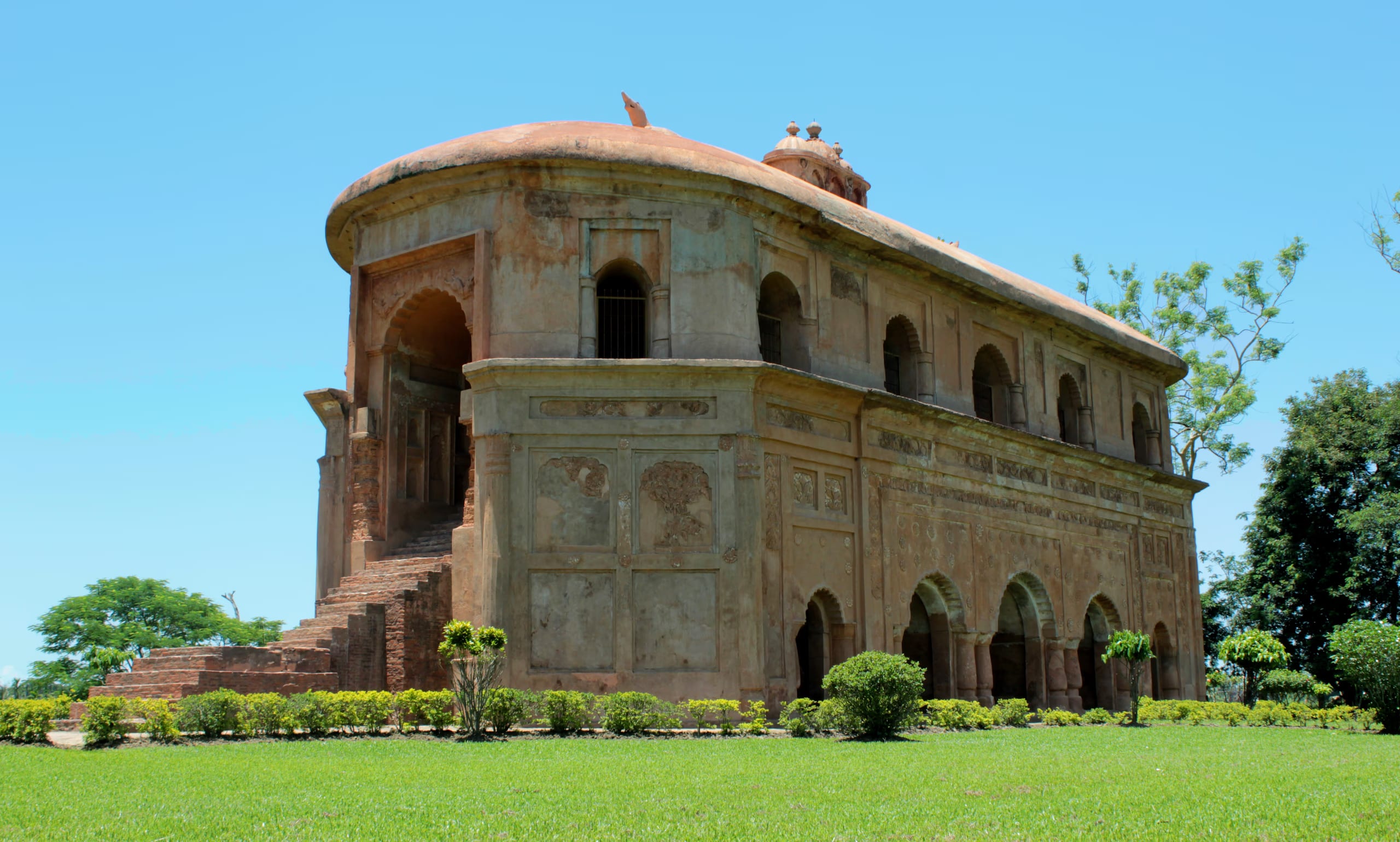
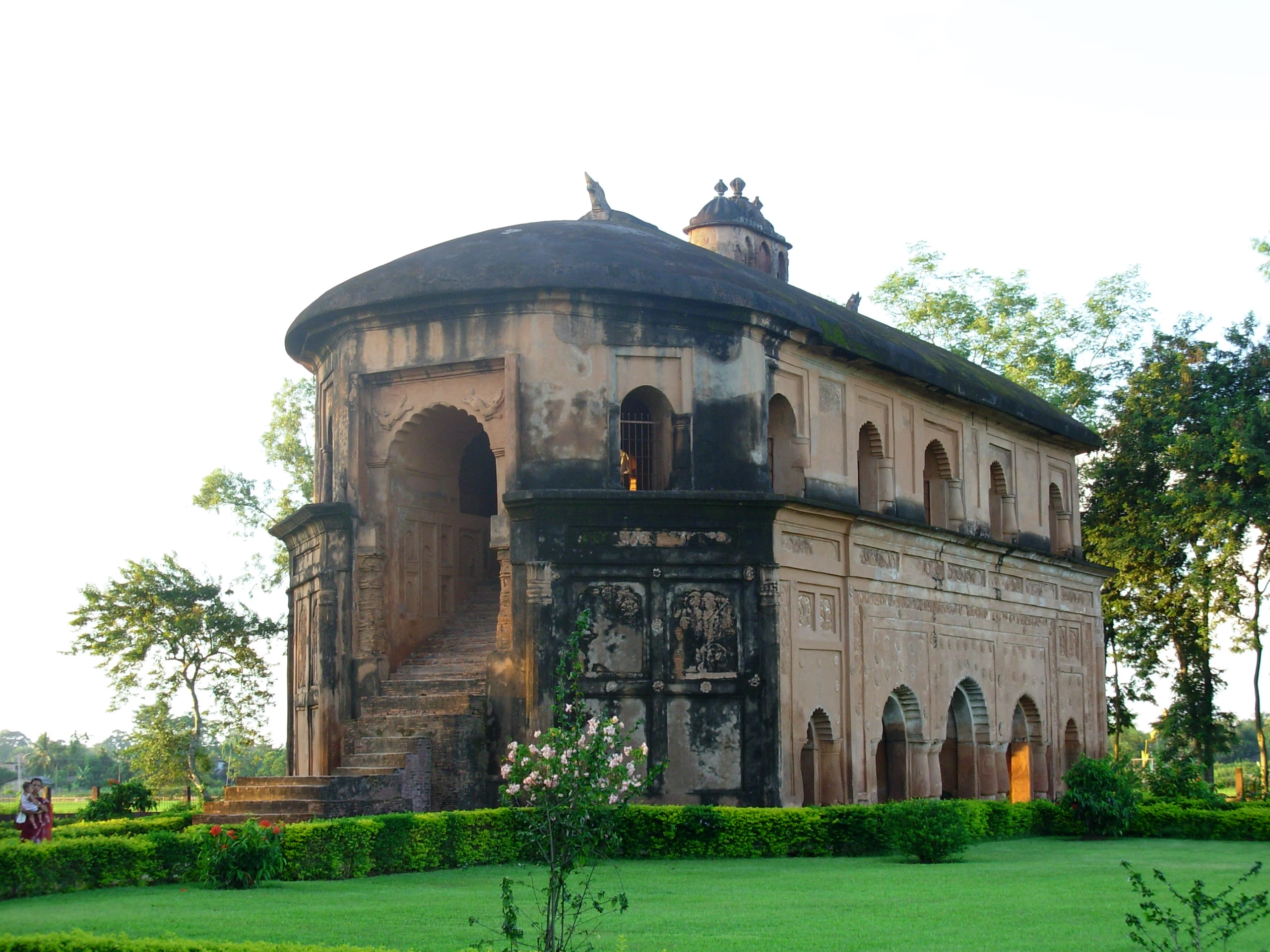
The Rang Ghar is an oval, two-tiered pavilion set on a high base of arched, vaulted chambers. The lower storey carries the upper gallery from which the royal party looked out. It is built of the thin, well-fired Ahom brick used across the capital. The brick was laid without cement, in an indigenous organic mortar. Tradition holds that this mortar was mixed from rice paste, eggs and other binders. The same recipe is credited with the durability of the kingdom’s brickwork in a wet, seismically restless country. Its most distinctive feature is the roof, shaped in the form of an inverted royal long-boat. Its ridge is finished with carved stone crocodiles, and the whole is ornamented with motifs of Ahom royal and sporting life. In the original arrangement, the upper gallery was reached not by an internal stair but by an external ramp. So the king ascended to his seat in procession rather than by a narrow stairwell. This small detail says much about a building conceived as ceremony from the ground up. The building was raised without cement, on a floodplain, in an earthquake zone. That it still stands in good order after nearly three centuries is itself a testimony to the skill of the Ahom masons and the quality of their mortar. It is one of the reasons the monument is studied as much for its engineering as for its history.
A theatre of the Ahom court
From the upper gallery the king and his nobles watched the spectacles mounted on the open ground below: the buffalo and elephant fights, the wrestling and the races, the dance and the festivity. This was above all during the spring Rongali Bihu, when the whole court gave itself to the celebration of the new year. The pavilion belongs, in other words, to the leisure and ceremony of a settled monarchy. It is a building made for watching rather than for defending or worshipping. As such, it is a rare survival anywhere in India of the recreational architecture of a pre-modern court. It is the physical setting of the games and gatherings through which an Ahom Swargadeo displayed his magnificence to his people. The Rangpur of brick and confidence in which the pavilion rose owed much to the settled prosperity of the reign of Pramatta Singha.
Emblem of the kingdom, and its survival
More than any other structure, the Rang Ghar has become the visual emblem of the Ahom kingdom in the modern imagination. It is reproduced on state insignia and in commemoration, and treated as the representative monument of the dynasty. So for most people, to picture Ahom Assam is to picture this pavilion. It stands today as a protected monument, conserved as one of the most important survivals of Ahom secular architecture. It lies within the cluster of royal sites around Sibsagar and Rangpur, alongside the neighbouring Talatal Ghar and the temples of the Sibsagar tank. With these it forms the architectural heart of the old capital. Like all early brick architecture in a high-rainfall, earthquake-prone region, it needs continuing care. The chief modern anxiety has been less for the fabric than for its setting, the once-open royal ground around it. Conservationists have fought to keep that ground clear of encroachment and vibration. Creeping development brings both to a monument never built to share its plain.
Visiting
The Rang Ghar lies a short distance from Sibsagar town in upper Assam, set back from the road on its open field. It is easily taken in a single circuit with the Talatal Ghar, the Kareng Ghar palace at Garhgaon, and the Sibsagar tank with its three temples. That circuit is the natural way to see the Ahom capital in a day. It is open to visitors as a protected heritage site, and floodlit in the evenings. It is at its finest in the spring months around Bihu, when the surrounding country is green. Then the festival the pavilion was built to watch is once again in full swing across upper Assam.