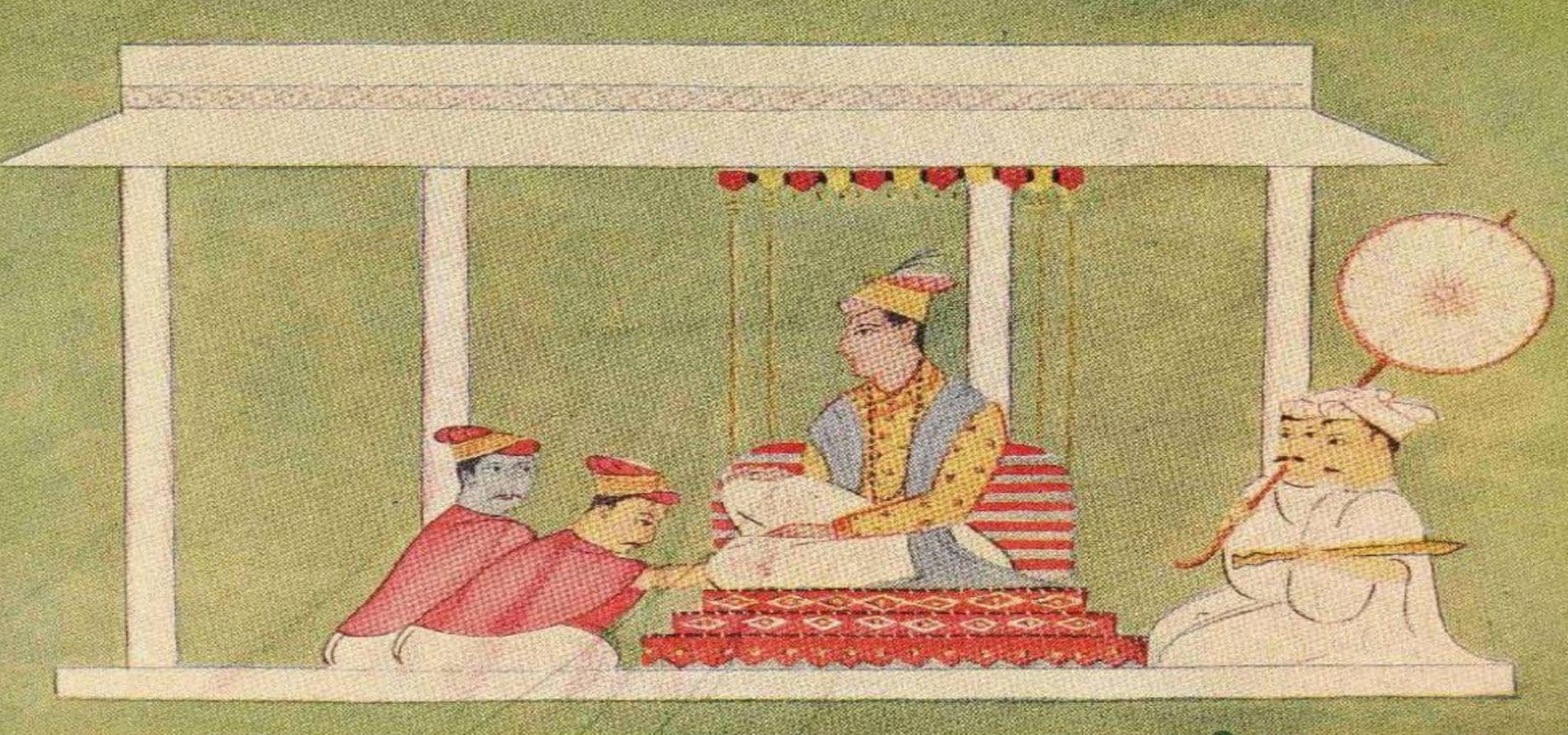
Rudra Singha, whose Tai name was Sukhrungphaa, reigned from 1696 to 1714. He ruled the Ahom kingdom at the height of its power, and is remembered as the greatest of its later kings. He was the son of Gadadhar Singha and of the martyred Joymoti, whose death under torture had cleared the way for his father's accession. His father had only just dragged the kingdom out of the long disorder of the late seventeenth century. Rudra Singha inherited it, and turned it into something it had never quite been before: a confident, settled, outward-looking power. It had a new capital, a court that drew artists and scholars from across northern India, and a grand design against Mughal Bengal that he did not live to launch.
Rangpur, a capital of brick and stone
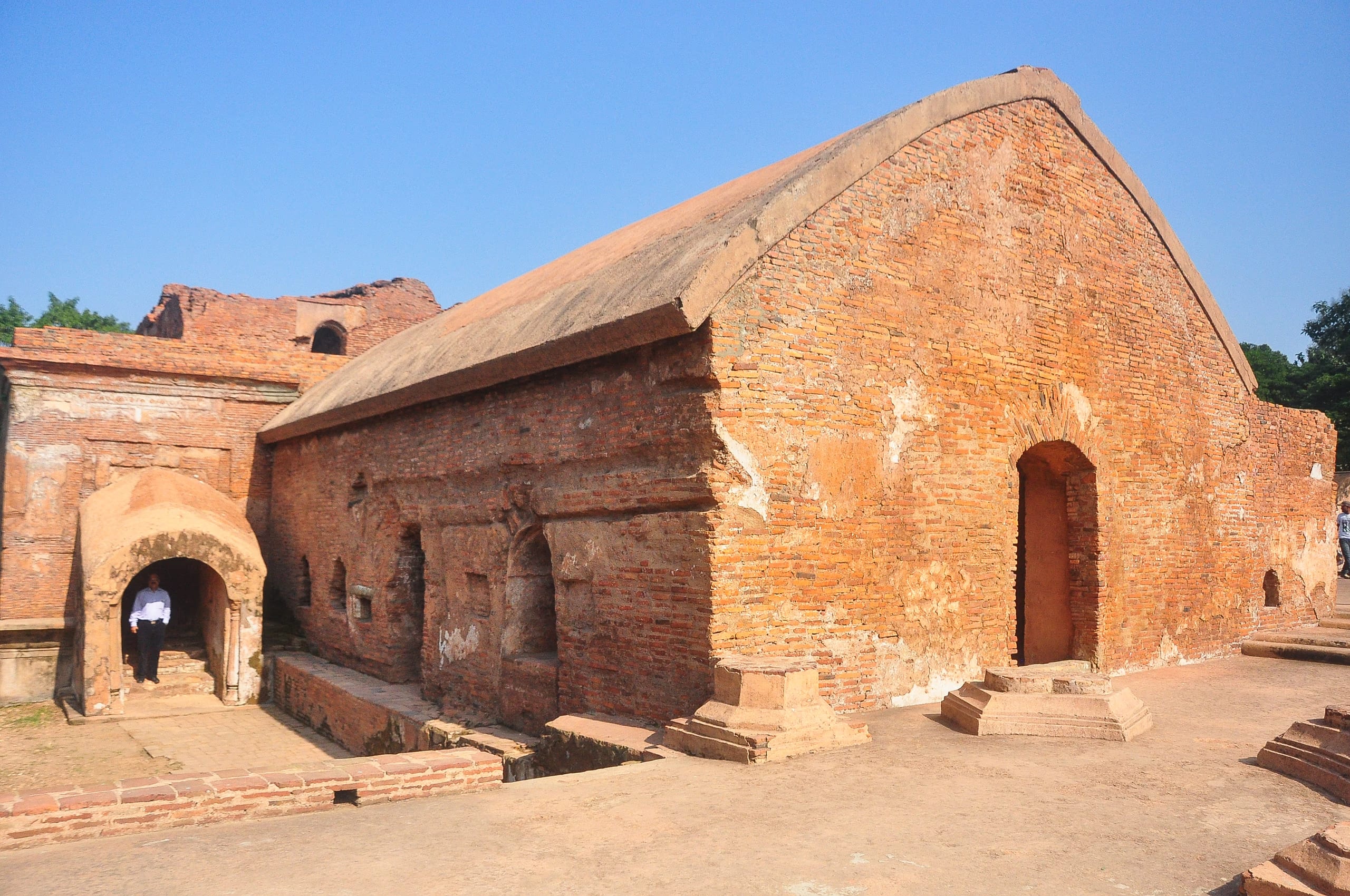
Rudra Singha's most lasting act was to move the Ahom capital to Rangpur, near modern Sivasagar, and to build it into one of the most impressive royal seats in eastern India. He shifted the seat of state there from Garhgaon around 1707, on a site then called Tengabari. The older Ahom capitals had been built of wood and earth. Rangpur was raised in brick and stone, and the king is rightly called the father of Ahom architecture. He is said to have brought a master builder, Ghanashyam, from Cooch Behar to lay out the new city. By tradition Ghanashyam was later put to death, caught carrying off a concealed map of the fortified capital. The great palace-fort of the Talatal Ghar, with its upper storeys above ground and its lower chambers below, was begun under him, even as its heaviest brick masonry was added by his sons. He drove the kingdom's roads outward from the new capital. These were the long embanked highways the Ahoms called ali, binding the country into the centre. Among his own works is the Namdang stone bridge of 1703, cut from a single mass of stone and still carrying the trunk road today. The monumental phase he began did not stop at his death. It was his sons who gave Sivasagar its great temples and tanks. Among them are the Sivadol, one of the tallest Siva temples in India, and the amphitheatre of the Rang Ghar. So the skyline of the Ahom golden age is, in large part, the dividend of the city he founded.
A court at its cultural height
Rudra Singha gathered to Rangpur a court of a brilliance the kingdom had not seen. His reign is the cultural high-water mark of the dynasty. He drew musicians, dancers, scholars, craftsmen and Brahmins from across the valley, and from Bengal and the Mughal north. He created new offices to keep the arts of his court, a Gayan Barua for music and dance among them. He sent Brahmin boys to study in Bengal and Bihar, and men to Delhi to learn its music. He adopted Mughal court dress and manners, without surrendering the Tai apparatus of his state. The Assamese drama and translation of the period, the work of court poets such as Kabiraj Chakravarti, belongs to his patronage. The chronicling tradition of the buranjis was strengthened under him. That is part of why the eighteenth-century Ahom court is so unusually well documented. He governed as well as he patronised, reforming the administration and the paik system that underpinned the state. So the splendour of Rangpur rested on a kingdom in good order, rather than on display alone.
Faith, and the seed of a later crisis
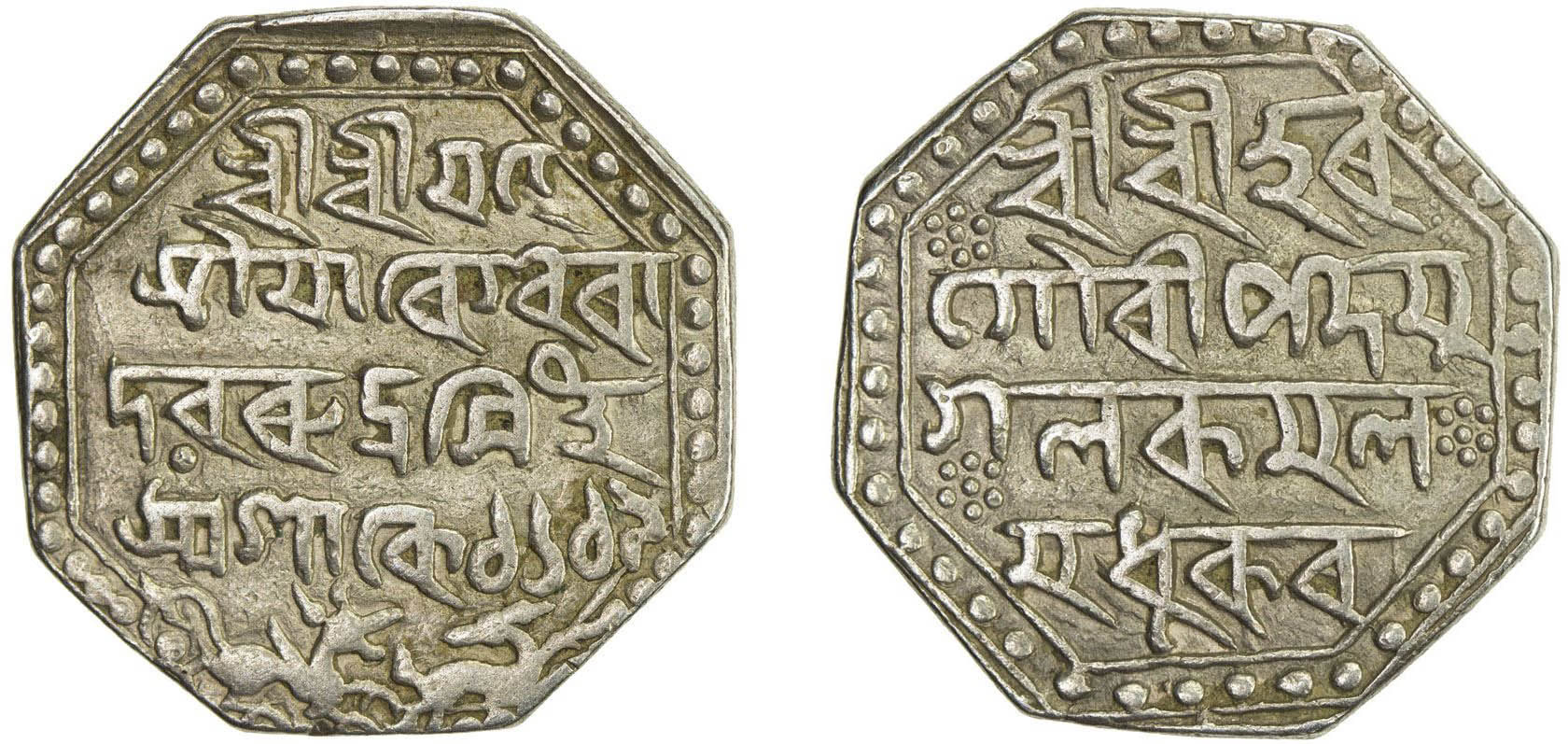
Rudra Singha's religious policy reveals both his statecraft and the fault line that would later break the dynasty. He undid the persecution of the Vaishnava sattras that had marked the recent past. He recognised four of them, Auniati, Dakhinpat, Garamur and Kuruabahi, as royal sattras, and reinstated their preceptors. He took initiation himself from the head of the Auniati sattra. Late in his reign, however, he turned toward the Sakta faith of the goddess. He invited the Bengali tantric scholar Krishnaram Bhattacharya, the Nati or Parbatiya Gosain of Nabadwip, to be his guru, promising him the management of Kamakhya. He died before the guru reached him. On his deathbed he charged his sons to take the initiation in his place. They did, and the consequences were grave. The Sakta ascendancy at court under his son Siva Singha fed the resentments that would erupt, two generations on, in the Moamoria rebellion. The king gave his line to the goddess, and in the same coin bought the golden age its most beautiful monument and its undoing.
The wars, and the unfinished campaign against Bengal
Rudra Singha turned the settled kingdom outward against its neighbours. In late 1706 he sent a large army south into the Dimasa Kachari hills, occupied the capital at Maibang early the next year, and forced the Dimasa king to accept Ahom overlordship. A second front opened against the Jaintia king soon after, when Jaintia seized the captive Dimasa ruler. These campaigns were costly and their gains were not always lasting, and revolts followed. Yet together they pushed Ahom authority further into the surrounding hills than before, and left the kingdom the paramount power of the eastern valley.
At the very end of his reign, Rudra Singha set himself the largest ambition any Ahom king had attempted: an invasion of Mughal Bengal at the head of a confederacy of the valley's powers. He sent envoys to the rulers of Cooch Behar, Tripura, Jaintia, the Dimasa hills and the Hindu courts of Bengal. At a great gathering at Rangpur in 1713 he announced the design aloud, meaning to drive the western boundary all the way to the Karatoya river, the old limit of ancient Kamarupa. He had been goaded to it by the Mughal governor of Bengal, who sent him robes in the manner a master sends to a vassal, an insult a king at the height of his power could not swallow. He framed the war as a defence of the dharma against Mughal power, and gathered a great army at Guwahati for the march west. Then, on 27 August 1714, eight days into a sudden illness, he died at his camp at North Guwahati. He was aged forty-nine, on the very eve of the campaign. The grand design died with him. He is said to have charged his sons to rule one after another, and four of them, beginning with Siva Singha, did in fact hold the throne in turn. Siva Singha let the confederacy dissolve and turned the kingdom inward. Yet the very scale of the attempt measures how far the Ahom state had risen since its beginnings as a small hill kingdom. It was now a power that thought in terms of marching on Bengal, not merely of holding its own river.
The dividend of his mother's silence
Rudra Singha is inseparable from the sacrifice that made his line possible. It was his mother Joymoti who died under torture rather than betray his fugitive father Gadapani. Her endurance allowed Gadapani to survive, take the throne as Gadadhar Singha, and pass it to their son. As king, Rudra Singha repaid that debt in the most visible way an Ahom monarch could. He excavated the great tank of Joysagar near Sivasagar in her memory, among the largest man-made tanks in India. It was dug by the labour of the paik levies, by tradition in a matter of weeks. The golden age over which he presided was, in a real and deliberate sense, raised as a monument upon her silence. The tank he dug for her remains the clearest statement of it.