Charaideo is where the Ahom kingdom began and where its kings were buried. It was the first capital fixed by Sukaphaa. It then became the dynastic necropolis, a landscape of maidams. These are the great burial mounds of the Swargadeos and their queens. Charaideo is the most sacred of all Ahom sites. In 2024 it was inscribed on the UNESCO World Heritage List. It was the first property from the northeast to be listed on cultural criteria alone.
The first capital
Charaideo was established by Sukaphaa as the seat of the new kingdom in the mid-thirteenth century. The working capital later moved, first to Garhgaon and then to Rangpur. Yet Charaideo kept a unique ritual primacy as the cradle of the dynasty. It was here, on a low range of hills, that the kings chose to be buried. So the site became less a city than a sacred ancestral ground. It was the spiritual centre of the Ahom state throughout its existence.
Because it was the cradle of the line, Charaideo gathered to itself the heroic memory of the kingdom’s early centuries. These were the generations in which a small band of Tai incomers fought their way to mastery of the upper valley. One of the most striking stories of Ahom valour belongs to those founding wars. It belongs too to the early Swargadeo Suhungmung, under whom the kingdom first became a great power. That story is told below.
Woven in a NightAn Ahom noblewoman could not weave her husband the armour-cloth that was held to make a warrior unkillable. When he fell, she armed a band of women and rode to the war herself.Read the story →The field of mounds
Charaideo is best understood not as a building but as a burial ground spread across a ridge.
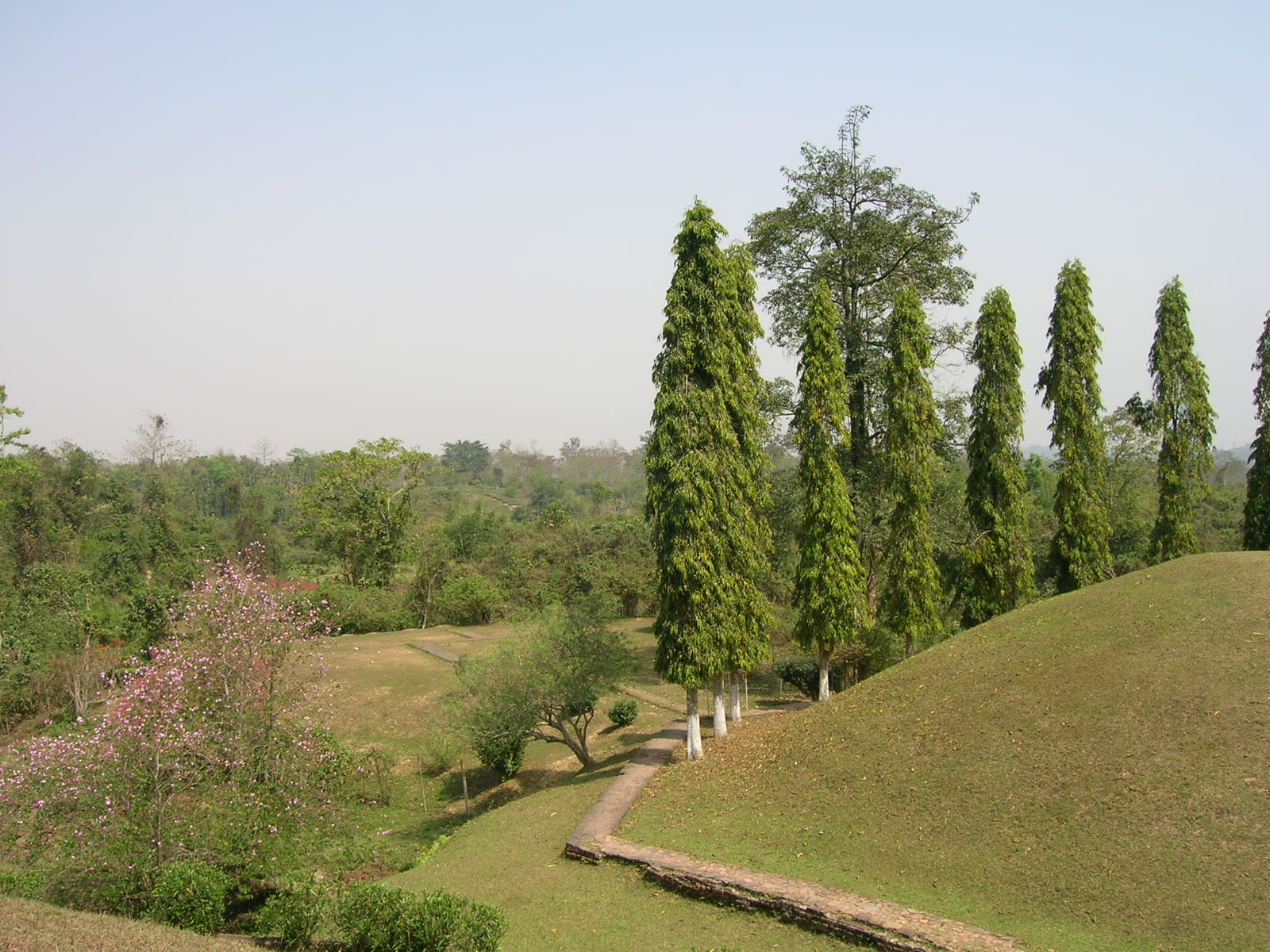
The defining structures of Charaideo are the maidams, the green burial mounds raised over the dead of the dynasty. The visitor meets not a single monument but a whole field of them. They are strung along a low range of hills some thirty kilometres east of Sivasagar town. The grandest stand like grass-grown pyramids. Each is ringed at the base by an octagonal dwarf wall and crowned by a small open pavilion. Early travellers wrote of them in just those terms, as objects of wonder rising out of the ridge. By tradition there were once more than a hundred and fifty mounds in all at Charaideo. Of these only about thirty are formally protected today, jointly by the Archaeological Survey of India and the Assam State Archaeology Department. The rest stand worn, encroached upon or quietly lost to cultivation and time. To walk the protected core is to move among the tombs of the Swargadeos and their queens, in the order the dynasty laid them down. The royal necropolis is kept apart from the mounds of princes and nobles. Those lie more widely scattered around Sivasagar and at Jorhat, Dibrugarh and Guwahati.
The architecture of the mounds
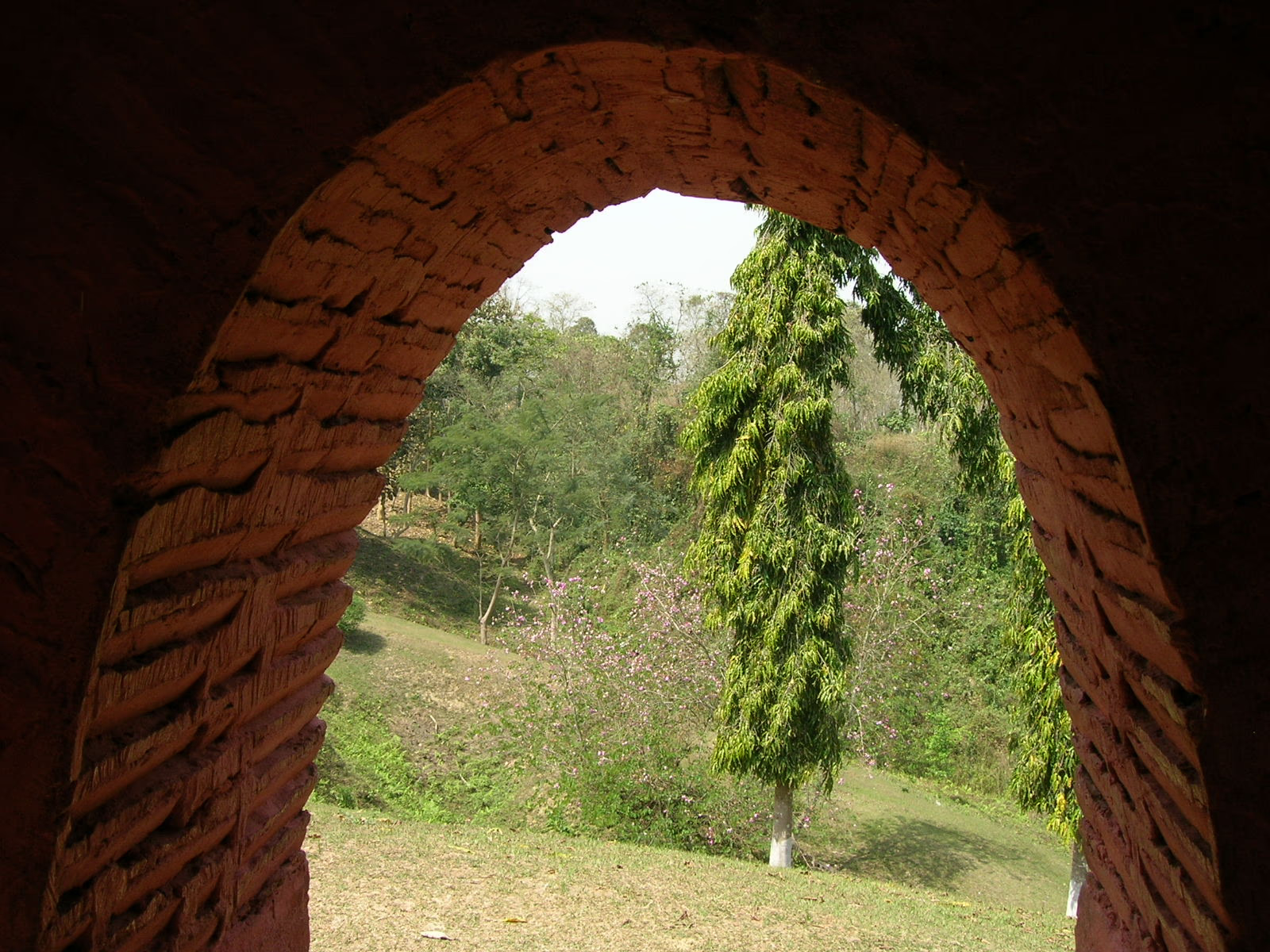
Beneath each visible hill lies a substantial vaulted chamber. In the earliest centuries these were built of timber poles and beams, and in the later ones of dressed and burned brick, sometimes of more than a single storey. It is an architecture of the dead that mirrors below ground the scale of the palaces the Ahoms raised above it. The dynasty carried this interment tradition with it across the Patkai from the Tai world to the east, and it gradually fused with local practice. So the maidams are a direct material link to the kingdom's Tai origins. They are a link too to the ancestor-worship of the Tai-Ahom rites that Padmeswar Gogoi described. One such vault was opened by the excavation of the chamber known as Maidam No. 2. The work was carried out by the Guwahati circle of the Archaeological Survey of India between 2000 and 2002, and the chamber is dated to the first half of the eighteenth century. It was a brick chamber encircled by an octagonal wall and entered by an arched door on the west. Robbers had broken into it in some earlier age. Even so it yielded the skeletal remains of five people, ivory decorative pieces worked with elephants, peacocks and floral motifs, a pillar-shaped wooden xorai and an ivory panel carved with the royal Ahom insignia. This was the buried world of a single ruler, held under the mound. The sequence of the royal burials and the contents of the unopened mounds remain central to the archaeology of the Ahom period. The protection of those that are still unexcavated is a live conservation concern.
The burial rite
A royal burial followed a fixed ritual path. The making of a royal maidam was an undertaking on the scale of a temple. The buranji of the Changrung Phukan, the officer of the king's works, sets down the materials gathered for a single royal mound at 1,225,460 bricks, with tens of thousands of dressed stones besides. A dead Swargadeo was carried out of the working capital by a road kept deliberately secret, and bathed before interment. He went into the earth with the goods and the household of his life. That rite turned at last from earth to fire as the court became Hindu. All of this is not the site's to retell but the story's, told below. The mounds are what the rite left behind.
How the Ahoms Buried a KingBy night the Ahom kings were carried to Charaideo and laid in great earthen mounds with their goods, and sometimes the living, in the moidam burials now on the UNESCO World Heritage List.Read the story →World Heritage and the sacred ground
In July 2024, at the forty-sixth session of the World Heritage Committee, the royal maidams of Charaideo were inscribed on the UNESCO World Heritage List. They were listed under the name Moidams – the Mound-Burial System of the Ahom Dynasty, under cultural criteria three and four, as reference 1711. It became the first World Heritage Site in the Indian northeast to be listed on cultural criteria alone, Sikkim’s Khangchendzonga of 2016 being a mixed natural-and-cultural property. The maidam tradition had long been known mainly within Assam. The inscription placed it on the same footing as the great burial landscapes of the wider world. It has brought new resources and new scrutiny to a site that still loses unprotected mounds to encroachment. And it recognises Charaideo for exactly what it is. The site is a single landscape that holds, together, the beginning and the burial of the Ahom line. It holds the founding capital fixed by Sukaphaa and the tombs of the kings descended from him. For all its new standing as heritage, it remains first a place of reverence. It is the ancestral ground of the longest-ruling dynasty the Brahmaputra valley ever knew.
Visiting
Charaideo lies in the Charaideo district of upper Assam. The mounds are set in protected parkland some thirty kilometres east of Sivasagar, from which the site is most easily reached. As a World Heritage Site it is best approached with respect for its standing as the ancestral ground of the Ahom dynasty. It pairs naturally with the rest of the old capital on a circuit of upper Assam. That circuit takes in the temples of the Sibsagar tank, the pleasure-pavilion of the Rang Ghar and the underground palace of the Talatal Ghar at Rangpur. The earlier seat at Garhgaon lies a little beyond. In this way the founding necropolis and the golden-age capital are seen together. The drier months from November to March are the most comfortable for the visit.